
I needed [Dr. Skeels] to understand, face-to-face, that we would do everything we possibly could, but that the organization needed to be transformed, and that was going to take resources. I wasn't quite sure how or what we were going to do, but I knew it needed to be done.

Spring 2026
Issue 1
75 Years of Membership
— Scott Becker, MS
The 1951 formation of the Association of State and Territorial Public Health Laboratory Directors (ASTPHLD) from the old Conference of Southern Public Health Laboratory Directors was a sign that the emerging field of public health laboratory science had gained a national, if not international, focus.
ASTPHLD brought together laboratory directors from 48 states and US territories in a collegial atmosphere, allowing the executives to share scientific, administrative and financial expertise at annual meetings and in refereed publications. Until the association changed its name in the late 1990s, ASTPHLD represented the interests of public health laboratories nationwide.
In August 1997, Scott Becker attended his first National Laboratory Training Network (NLTN) meeting in Edmonds, Washington. Becker and Carol Clark flew to Portland, Oregon prior to the meeting to brief Dr. Mike Skeels, the head of the Oregon public health laboratories and then ASTPHLD president, on the association’s dire financial straits.
“I needed him to understand, face-to-face,” Becker said, “that we would do everything we possibly could, but that the organization needed to be transformed, and that was going to take resources. I wasn’t quite sure how or what we were going to do, but I knew it needed to be done. He did not really like hearing about the resource challenges, but he listened intently and heard it.”
Becker and Clark left Skeels and took a four-hour train ride from Portland to Seattle for the NLTN meeting. During the ride, the two staffers methodically listed everything that needed to be changed in the association: a new name, a more inclusive membership, tools for increasing the association’s public image, budgets, and importantly, increasing federal government financial support for the organization’s mission. At the top of the list was the need to change the association's name.
The name change also implied a more inclusive organization with new membership categories. Mike Skeels chaired a January 1998 board meeting that began to examine Becker’s proposed changes. At that organizational meeting, opponents to the changes were numerous and vocal. They argued that county, local and private laboratory staffers could belong to any number of scientific organizations, and that ASTPHLD’s very exclusivity made it an elite organization in the public health community.
But supporters of the proposed changes made the case with equal passion that the organization was stretched too thin with its 56 members. “We had been talking for many years about bringing more people in,” Dr. Carl Blank said. “We were talking about a broader perspective that was not restricted to state laboratories. The board needed to represent laboratories. It couldn't restrict membership.”
“The idea of expanding the membership preceded the name change,” Dr. Burt Wilcke said, adding that the suggestion had first been made and voted down at the 1993 annual meeting in Minneapolis. “But it was obvious that we had to have the name change to attract new members.”
The vote, as Becker recalled it, “was very close. It was a real challenge. They kept voting-up, down, up again-and it was one of these emotional, passion-filled type of things.”
— Excerpted from APHL 50th Anniversary: Looking Back, Looking Forward

Membership by the Numbers
| December 2011 | December 2025 |
768 | 1,696 |
| members in six categories | members in seven categories |
APHL's Member Categories
APHL brings together institutions and individuals who recognize the value public health laboratories provide to their communities and jurisdictions. Since the early 2000s, we have added membership categories to reflect the breadth and depth of knowledge that public health laboratories bring to any public health conversation:
Public Health Institutional - State: Any of the public health laboratories of the states, territories, and commonwealths, including the District of Columbia, of the United States are eligible for membership in this category.
Public Health Institutional - Local: Any of the public health laboratories of the counties, parishes, municipalities, cities, townships, boroughs or other localities within the US, as well as any US-associated Pacific Islands, are eligible for membership in this category.
Public Health Associate Institutional (PHAI): Environmental laboratories, agricultural laboratories, state chemical laboratories, and other laboratories of the states, territories, and commonwealths, including the District of Columbia, of the United States, as well as any US-associated Pacific Islands, who are interested in public health issues are eligible for membership in this category.
Individual: Persons who have an interest in public health and are not otherwise eligible for membership can join us in this category.
Student: Those individuals that are currently enrolled in an undergraduate or graduate program related to public health laboratory science (e.g. microbiology, chemistry, public health, environmental health, etc.), or are a fellow or intern at a public health laboratory are eligible for membership in this category.
Sustaining-Corporate Colleague: Added in 2013, this membership category recognizes industry or corporate entities that have an interest in public health or environmental laboratories.
Our members are also very active in not only the governance of APHL, but also the forward-thinking work of public health. Over 5,000+ members of committees, subcommittees and workgroups advance public health laboratory science, educate future public health leaders, make connections across industries and power technology innovations across the public health community.
For more on APHL’s membership, and becoming a member, please visit APHL.org.
Member Resources for Success
Your laboratory's membership gives you access to:
- Laboratory trainings
- ColLABorate communities
- Technical publications, tools and resources
- eUpdate newsletter
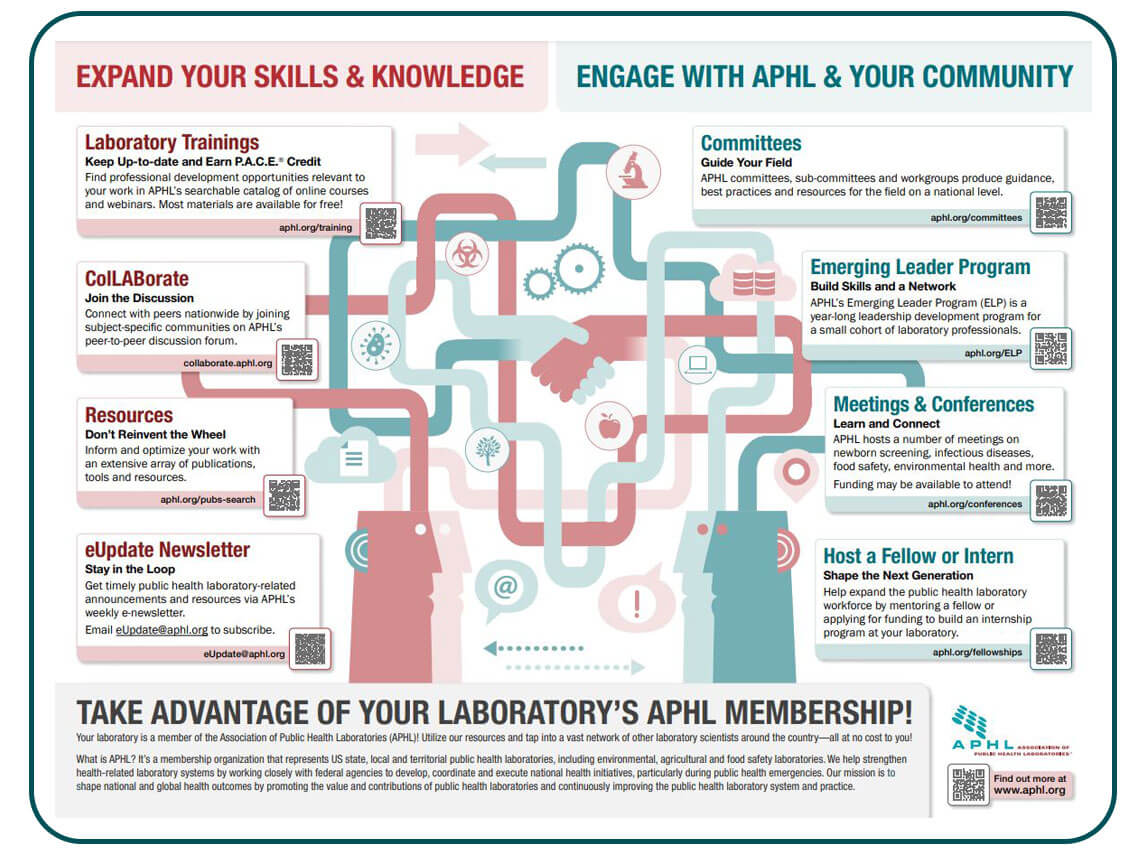
 Scan the QR code for a full-sized version of this Take Advantage of Your Laboratory's APHL Membership poster that contains QR codes to APHL's various member resources, such as guides, toolkits, newsletters, laboratory trainings and more!
Get More from Lab Matters: