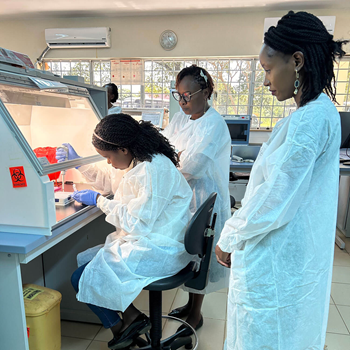
APHL brings extensive expertise in biosafety and
biosecurity, including risk assessment, laboratory design, best practices,
assessment tools, and high-containment laboratory commissioning. We provide
technical assistance and training on biological risk assessments, risk
mitigation planning, and safety controls, including biological safety cabinets,
facility design and construction, personal protective equipment, and safe
laboratory practices and procedures. Our work strengthens laboratory capacity
to protect staff, safeguard the environment and ensure the integrity and
quality of laboratory operations.
APHL equips laboratories with digital solutions and workforce development strategies to modernize laboratory informatics systems. We specialize in evaluating and implementing Laboratory Information Systems (LIS) and recommending applications that streamline processes and improve data reporting. Our work focuses on four core areas:
- Automating data to reduce manual processes
- Enabling interoperability for seamless data exchange
- Applying advanced data visualization for actionable insights
- Building workforce capacity through specialized training.
From centralization and standardization to real-time
analytics, we support laboratories in effectively leveraging data for timely
public health decision-making for public health surveillance of outbreaks.
Our comprehensive training portfolio covers software-specific applications,
data visualization techniques, LIS evaluation, selection, and implementation,
and the technical skills needed to maximize your laboratory's informatics
workforce.
APHL provides training programs that build the capacity of laboratory leaders and managers to ensure quality services and strengthen national laboratory systems. Courses cover leadership development, strategic planning, and essential management skills for leading teams, resources and operations. Our trainings equip laboratory professionals with skills in evidence-based decision-making, strategic planning, resource management, communications and team leadership.
APHL offers laboratory-specific leadership and management programs that emphasize both strategic and practical skills, enabling laboratory leaders to inspire change, improve systems, deliver quality services and support laboratory system development and maintenance.
APHL enhances laboratory capacity for the timely detection, identification and response to infectious disease threats. We provide training on key pathogens, including influenza, SARS-CoV-2, RSV, sexually transmitted infections, mpox, tuberculosis, Ebola, vector-borne and vaccine-preventable diseases. We also strengthen antimicrobial resistance detection by assessing laboratory capabilities, offering training and facilitating collaboration with clinical partners. Training emphasizes laboratory competencies, quality management and technical methods to improve diagnostic accuracy and surveillance capabilities.
APHL supports laboratories in adopting and scaling next
generation sequencing (NGS) for routine and emerging pathogen surveillance,
outbreak response and public health decision-making. NGS provides critical data
to guide evidence-based policy and response, but its implementation requires
investment in infrastructure, expertise, and workforce development. APHL
provides training, technical assistance, and strategic planning to help
laboratories build sustainable NGS capacity—from sample preparation and
sequencing to data analysis and interpretation for public health action.
APHL advances a culture of quality in public health laboratories by supporting the development and implementation of quality management systems (QMS) aligned with international standards such as ISO 15189 and ISO 17025. QMS encompasses the 12 quality system essentials, which guide laboratory policies, processes, and procedures to ensure regulatory compliance, efficiency, and continuous improvement. APHL provides assessment, training, and technical assistance in internal auditing, method validation and verification, and ISO accreditation processes to strengthen laboratory quality and reliability.
APHL supports the assessment, training and development of public health laboratories to build and maintain their quality management system in part by providing training on ISO standards and quality management systems, with a focus on internal auditing and method validation and verification.