APHL Honors 2025 Newborn Screening Award Winners
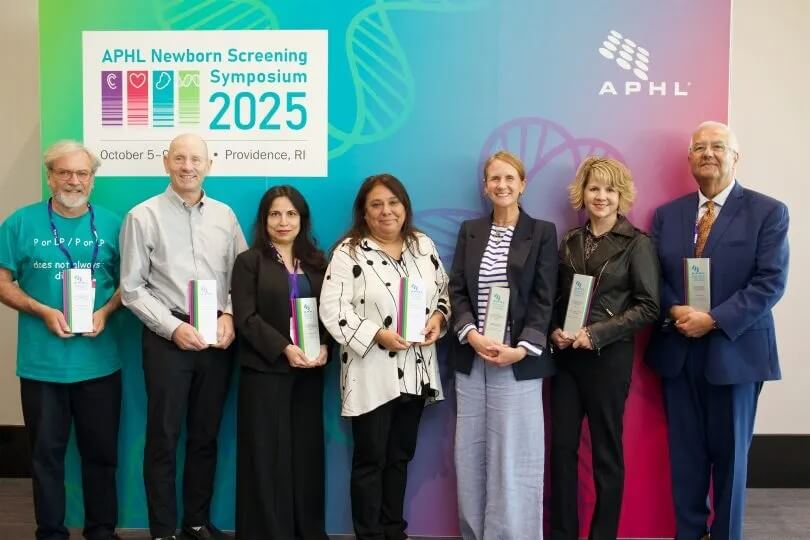
At the 2025 Association of Public Health Laboratories (APHL) Newborn Screening Symposium, APHL presented six awards to leaders who have made significant achievements in the field of newborn screening. The winners were announced during a ceremony on Tuesday, October 7. Congratulations to all award winners!
The following awards were presented:
The Achievements in Public Health Informatics Award honors someone who has made significant contributions to the newborn screening system in one or more of the following areas: enhancing implementation practices for electronic messaging; developing strategies for achieving effective data management; improving laboratory capability for health information data exchange; and providing new and creative approaches to communicate findings through data visualization. This year’s award recipient is:
- Dari Shirazi, Association of Public Health Laboratories (retired)
The Clinician Champion Award honors someone involved in patient care and who has made significant contributions in one or more of the following areas: ensuring newborns receive adequate screening and appropriate follow-up; assuring timely and effective communication of screening results to patients and families; and contributing to efforts to strengthen the impact of the public health newborn screening system by being directly involved in follow-up care, community affairs, newborn screening advocacy and/or community activities. This year’s award recipient is:
- Joseph Muenzer, MD, PhD, director, Muenzer MPS Research and Treatment Center; Bryson Distinguished Professor in Pediatric Genetics, University of North Carolina at Chapel Hill
The Everyday Life Saver Award in Newborn Screening honors a person working in newborn screening or a family, patient, advocate or individual who has made significant contributions to the field of newborn screening. This award highlights the ongoing ways the recipient contributes to the morale of a newborn screening team and/or the operations of a newborn screening program, or ways in which the recipient champions the growth, knowledge-transfer and/or ethos of the newborn screening system. This year’s award recipient is:
- Jill C. Skrabal, PhD, clinical nutrition therapist and metabolic nutrition specialist, Newborn Screening Program, Nebraska Department of Health & Human Services; assistant professor of pediatrics, University of Nebraska Medical Center
The George Cunningham Visionary Award in Newborn Screening is given to someone who has made the greatest contribution to expanding or improving the screening of newborns by public health agencies in one or more states. This year’s award recipient is:
- Joseph Orsini, PhD, deputy director, Newborn Screening Program, New York State Department of Health Wadsworth Center
The Harry Hannon Laboratory Improvement Award in Newborn Screening honors those who have made significant contributions in one or more of the following areas: assuring the quality of testing, enhancing the specificity of tests, establishing new creative laboratory approaches and technologies, providing laboratory training/education for new technologies and tests, or improving the detection of newborn disorders/conditions. This year there are two recipients. They are:
- Michael Gelb, PhD, Boris and Barbara L. Weinstein Endowed Chair in Chemistry, University of Washington
- Patricia Hunt, manager, Newborn Screening Metabolic Branch, Texas Department of State Health Services
The Judi Tuerck Newborn Screening Follow-up and Education Award honors those who have made significant and outstanding contributions in one or more of the following areas: enhancing the caliber of the newborn screening system; improving follow-up and education; developing creative short term follow-up strategies that significantly reduce the time to diagnosis and treatment of affected infants; developing or enhancing long term follow-up strategies; establishing novel approaches or methods for managing the integration of new technologies in newborn screening; translating novel approaches or methods into best practices or guidelines for follow-up and education; providing innovative newborn screening follow-up training/education for best practices; and improving practices to ensure timely detection, reporting, intervention and treatment for newborns detected with disorders/conditions. This year there are two recipients. They are:
- Inderneel Sahai, MD, chief medical officer, New England Newborn Screening Program, UMass Chan Medical School
- Angela Wittenauer, assistant professor, Newborn Screening Follow-up Program, Department of Human Genetics, Emory University
APHL congratulates all award winners, and thanks them for their contributions to advancing the essential work of newborn screening.
Newborn screening—recognized as one of the largest and most successful disease prevention systems in the US—is the practice of testing every newborn baby for certain harmful or potentially fatal genetic conditions that may not be otherwise apparent at birth. Early detection is crucial to prevent death or a lifetime of severe disabilities.
Learn more about the APHL Newborn Screening Symposium.
About APHL
The Association of Public Health Laboratories (APHL) works to strengthen laboratory systems serving the public’s health in the US and globally. APHL’s member laboratories protect the public’s health by monitoring and detecting infectious and foodborne diseases, environmental contaminants, terrorist agents, genetic disorders in newborns and other diverse health threats. Learn more at www.aphl.org .
Questions? Learn more about APHL