.png?sfvrsn=a4dc1c5f_6)
APHL Is 75! We Take a Look Back—and Forward—With the Organization’s Longest-Tenured Employee
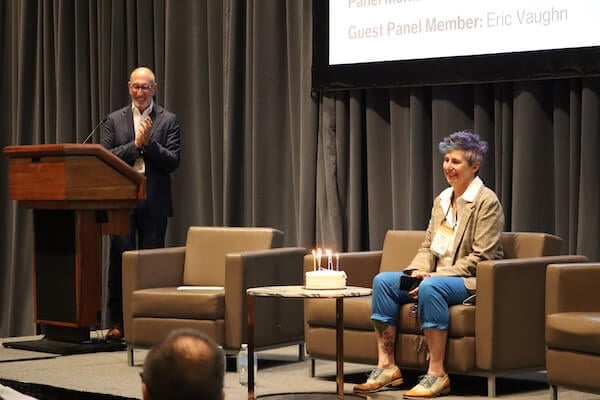
APHL is turning 75, and Carol Clark, the organization’s chief operating officer, has been with the organization for 29 of those years—years when APHL’s mission and membership have grown by leaps and bounds.
What did APHL look like in 1997 when Carol started? Why did she choose to make it home for almost three decades? Where does she see the organization headed in the future?
We sat down with Carol to ask all that and more. Read on to learn more about her experiences as APHL’s longest-tenured employee!

What was your first day on the job like?
The onboarding process was not nearly as robust as it is today! I remember someone giving me my benefits package and a bunch of forms that I was supposed to sign and return. And I’m 99% sure no one took me to lunch. Instead, we all ate in this small conference room. Initially, people were wary of me because they were distrustful of my boss. But eventually they got to know me for me—and six months later Scott [Becker, APHL’s current CEO] joined the organization.
What do you remember about your early days at APHL?
I started on January 13, 1997, and I was hired as the controller. The old controller had left, we had no CEO and we were in the midst of a programmatic audit review by the US Centers for Disease Control and Prevention. It looked like at the end of the fiscal year we were going to have about a $300,000 deficit. Red flags were flying everywhere, and I was questioning my decision. We also didn’t have voicemail, and the computer network only really worked for the two accounting department computers. Even late last century, voicemail and networked computers were standard for nonprofits. We had email, but no one used it. There were about 10 people in the office and when we communicated with each other, we wrote memos on letterhead, printed them, copied them and then put them into each person’s mail slot. Seriously! I had come from an organization that had 20,000 members and a 2,000-person annual conference. So this definitely felt strange. But then Scott [Becker] came on board and things started to change. He began using email and I was like, finally!
What roles have you held at APHL?
I like to say I grew up with APHL. As the organization grew, I took on more and more roles. In addition to controller, I was the associate executive director (AED) for finance and administration (F&A). During that time, I was responsible for accounting, human resources, membership, facilities and information technology. Then I was promoted to chief operating officer. I’ve held that position for over 20 years. Over the years, the operations area has grown and matured. In addition to the responsibilities that I had as AED for F&A, legal and compliance, marketing, communications, grants management and information solutions were added to my portfolio. I now also work closely with our informatics and global health programs and with Scott and the board on organizational strategic initiatives. You ask me what roles I had, and honestly, I can’t remember all my titles. But I was always controller. That I remember for sure!
What attracted you to APHL?
There had been a lot of upheaval at my old job, and it became clear to me that I was not going to have the sort of career path I had hoped for there. What initially attracted me to APHL was they were offering me a job that I knew I could do—and at the time, it was a fairly niche skill. The job seemed interesting and it fit within my skillset.
What’s kept you at APHL for 29 years?
I had only planned to stay at APHL for five years and then go on to my next big challenge, but when you look at APHL and our work, there’s always the next big challenge. In 2001, there was 9/11 and the anthrax attacks, which brought a focus on public health laboratories and a lot of growth to the organization. And then later in the decade, there was H1N1. Then there was a period when things were stable, and that’s when I had young kids and it was important to me to be with a family-friendly organization like APHL. So, it just made sense to stay. During this “quiet time” I was also working with our global health program to establish and formalize our overseas offices and work. And then, of course, there was COVID-19. There was never a long period of boredom. There was never a period when I scratched my head and said why am I still here? Also, APHL is a great organization, with amazing people, awesome members and a supportive environment. Why would I want to leave all that?
What is your favorite thing about APHL?
That’s like asking me which child I love the most! I think the thing I like the most is the people, and by that, I mean the staff and the members. I think public health professionals are drawn to this type of work almost as a calling. They have a desire to give back and do more, and I think that permeates throughout the organization. I really enjoy that mission and being a part of something bigger than myself.
What do you think APHL will look like in the future?
We’re navigating some really tough times right now, but I think we will come out of it stronger. We have the opportunity right now to reinvent ourselves, to really think about the things that are important to us and how we can accomplish them. The organization is resilient. We’ve dealt with adversity before and I think we’ll get through this and thrive. That’s my prediction, and that’s what I want for us.