.png?sfvrsn=a4dc1c5f_6)
Public Health Has a Marketing Problem: APHL 2025 Keynote Speaker Addresses How to Fix It
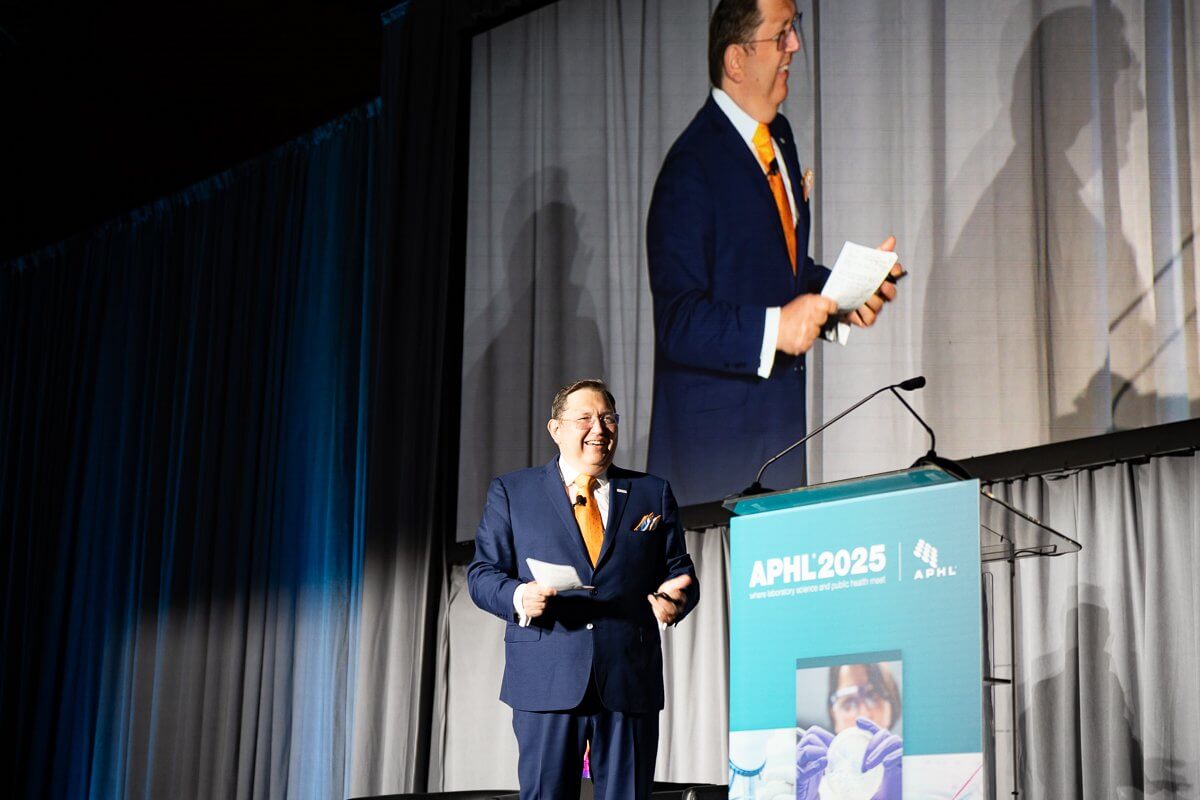
“Visibility isn’t vanity. Talking about the value of public health is crucial to the survival of our field and our nation.”
Those were some of the opening remarks of Brian Castrucci, DrPH, president and chief executive officer of the de Beaumont Foundation and the keynote speaker at the 2025 APHL Annual Conference held in Portland, Oregon, May 5-8.
Castrucci, who addressed a packed ballroom of laboratory scientists and other public health professionals, gave the conference’s Dr. Katherine Kelley Distinguished Lecture entitled, “Leading from the Lab: Rising to the Challenge, Reclaiming Public Health.

Starting with the basics: Defining public health
Public health has long had an identity crisis, said Castrucci, who noted it’s often confused with medical care.
“People know medicine. They understand medicine. So their brains default to medicine,” Castrucci commented. “But medicine helps one person at one time. You help everybody, every day. You catch outbreaks before they happen. You make sure lead is caught in the water before kids get sick. You touch every newborn child in this country through newborn screening. There are people who do a whole lot less than you do—and we hear about what they do because they tell us. Every day. We can’t stay silent.”
The first step to communicating public health’s impact is talking about it, said Castrucci, who urged the audience to create “better marketing for public health—better clarity of its value and purpose.”
Citing a recent Harvard/de Beaumont Foundation poll showing that both Republicans and Democrats trust and think positively about the US Centers for Disease Control and Prevention and local and state health departments, Castrucci pointed out that despite political polarization and funding cuts, the public is pro public health. And that should be a confidence boost, as well as a rallying cry, to an understandably beleaguered profession.
“This is the time to speak proudly about what you do,” emphasized Castrucci. “You save lives every day. And when you think about how to communicate that, don’t limit yourselves. You not only help poor and vulnerable communities. Public health helps every person in every corner of every county in this country.”
Raising our voices
When communicating the value of public health, Castrucci urged the audience to use stories, not data.
“Stories have a stickiness about them that data doesn’t,” he said. “You don’t need to be loud. You don’t need to go to town council meetings or get on the news. You can tell your stories through LinkedIn or at your kid’s soccer game. Where doesn’t matter. Just make sure you’re talking.”
And to make those stories more accessible, Castrucci advised using clear, common language—not jargon or highly scientific terms. “Disseminating information is not communicating,” he said. “That’s just pushing data out. Communicating takes interaction between parties to reach a shared understanding.”
To get to that shared understanding, Castrucci had some tips:
- Emphasize why public health is important to people. “Tell people what’s in it for them. Tell them why they should care about public health,” Castrucci emphasized. “Talk about lead in water and newborn screening. This is your mission now.”
- Be proactive. “Don’t wait for misinformation to go viral,” he said. “Make sure your lab is a source of information for people. Your value is in your neutrality and your science.”
- Use science, not value or politics, when communicating. “The science is universal, but the values aren’t,” Castrucci said.
- Don’t speak with certainty if there is none. “Telling someone ‘We don’t know yet’ is a valid answer,” he said. “Let them know that this is what we know today, and when we know more, we will get back to you.”
- Cultivate appropriate messengers. “People don’t trust the media, they don’t trust the government,” Castrucci said. “But they do trust their religious leaders, their employers and social influencers. Build relationships with trusted messengers. And don’t cultivate these relationships in a crisis. It just won’t work.”
- Maintain visibility. The pandemic may have waned, but your public health messaging shouldn’t, noted Castrucci, who pointed out that people trust who they know. Stay in the public’s eye.
“This is the job you all have,” said Castrucci in closing. “Your job is not just to run the test, it is to raise your voices—to lead, to educate and to illuminate the value of public health. I know you’re feeling overlooked, even invisible. But you are not those things. You are indispensable to the future of our nation. You now need to convince everyone else of the same thing. This is your moment—not to shrink, but to grow.”