.png?sfvrsn=a4dc1c5f_6)
The Rules of Public Health Action Are Changing. How to Adapt and Win Back Public Trust
The nation’s public health system is in chaos.
Funding for public health programs has been severely cut. Leadership at the US Centers for Disease Control and Prevention is in near-constant flux. Long-held vaccine guidelines have been upended. Diseases considered eliminated are on an alarming trend upward.
The rules that once guided public health action—from leaning into the science to putting stock in responsible, unbiased news sources—are changing, said Joshua Sharfstein, MD, vice dean for public health practice and community engagement at Johns Hopkins Bloomberg School of Public Health, who delivered the Katherine Kelley Distinguished Lecture at the 2026 APHL Annual Conference.
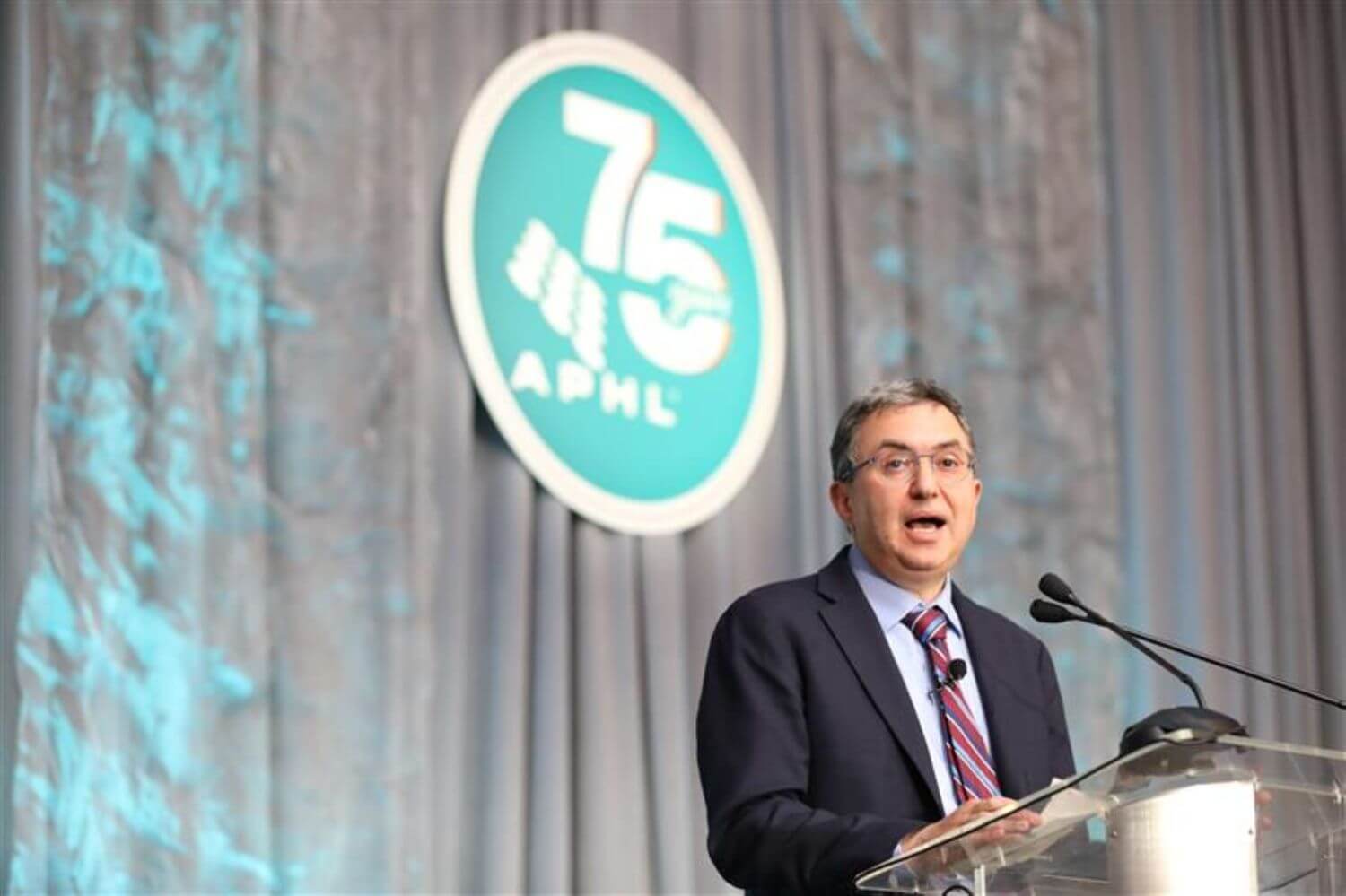
Sharfstein, who outlined the rules and offered advice on adapting—and advancing—delivered the keynote address during APHL’s 75th anniversary year to a packed audience of more than 1,400 public health laboratory professionals from all 50 states and the District of Columbia, gathered in Baltimore, Maryland, on May 4.

A new public health playbook
Sharfstein, co-author of Information Sick, began his address describing the decline of responsible journalism and the subsequent rise of misinformation and scientific mistrust.
“Here’s the first rule of the game that is changing: If the source of truth is disappearing, people are going to go their own way to find information,” Sharfstein explained. Some of that information comes from social media or fringe journalism, and not all of it is accurate, he noted. “People are frustrated with the nation’s healthcare system,” Sharfstein said. “They think ‘Maybe my doctor really is in cahoots with the pharmaceutical industry. Maybe there is a better, different, cheaper way.’ This decline in scientific trust is a huge challenge for all of us in public health.”
Rule number two—that public health decisions should be made with integrity—is also at risk, said Sharfstein, a former Food and Drug Administration (FDA) deputy. “Just because I put principal deputy at the FDA in my email signature didn’t allow me to wake up and say, ‘This is what we’re doing.’ We had a thoughtful process we had to go through, and this is why people trusted the FDA.”
Sharfstein noted that now, in addition to external input, there’s been a stacking of advisory committees with unqualified scientists—or the decision not to use advisory committees at all and simply rely on a group of hand-picked individuals. What’s more, when decisions are reached, they’re increasingly communicated via social media rather than in policy documents that explain their rationale. And just as disheartening, those who oppose these decisions are often subject to censorship.
Moving forward
The third rule Sharfstein mentioned isn’t one that’s changed—except, perhaps, in its importance--and that is that people need public health more now than ever.
“We have a massive measles outbreak,” Sharfstein commented. “We have a huge syphilis outbreak in parts of the country. We have environmental catastrophes that require a lot of lab work. We have all kinds of challenges. Sometimes people will grab on to some piece of information that’s inaccurate to quell their anxiety. But ultimately, people want what’s best for them and their families. They want to be healthy. They want their communities to be healthy. And that’s as true now as ever.”
One way to build trust, said Sharfstein, is to elicit public engagement in decision-making. “Put out a draft of a policy,” he said, “listen to what people have to say and conduct outreach across communities, particularly across communities that are suspicious.”
Sharfstein’s final changing rule is moving public health from the shadows out into the forefront, noting that public health work, while essential, is often invisible. “Public health saves lives every day,” he said, “but people don’t know it.”
How do we gain visibility? Collaboration and connection are key, Sharfstein said.
He urged the audience to look for engagement with emerging media sources, like publications dedicated to public health issues; to employ community ambassadors who can meet people face-to-face, where they are, to dispel misinformation and answer questions; and to join forces with trusted community/religious/academic leaders who can help spread public health’s message and amplify its work.
“Find ways to have as many people as possible appreciate what you’re doing,” Sharfstein advised. “Trade in your invisibility for flight. As you do good work, and keep moving forward and learn to fly, I believe you will be changing the rules of the game in the future.”