.png?sfvrsn=a4dc1c5f_6)
APHL Trainers Hold Workshop on Data Actionability in Chile (Disponible en Español)
Por favor, desplácese hacia abajo para ver la versión en Español de este artículo.
Collecting data is one thing. But how do you actually put it to good use?
That’s the question posed by APHL trainers at a recent workshop to members of the Instituto de Salud Publica (ISP) in Santiago, Chile. ISP is the country’s laboratory division of its Ministry of Health.
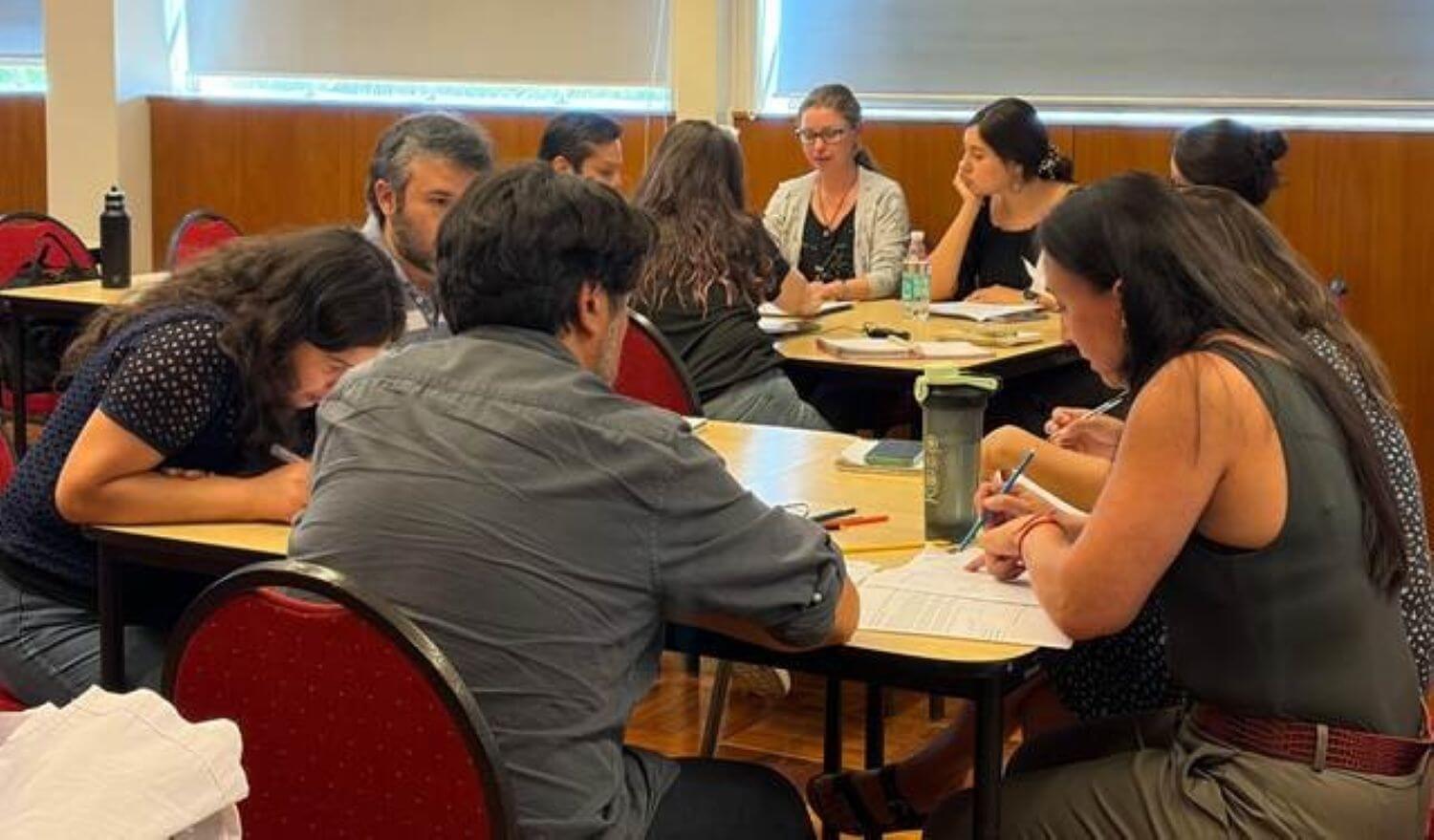
In January 2026, APHL’s Adolfo Lara, PhD, specialist, Global Heath, Julia Pringle, PhD, lead specialist, Global Health, and Matthew McCarroll, principal specialist, Global Health, delivered three concurrent sessions that focused on different aspects of data actionability. The trainings, attended by roughly 30 ISP staff, were developed by APHL with funding support from the US Centers for Disease Control and Prevention’s Global Health Security Partnerships.

Phylogenetics
A training on advanced phylogenetics, a discipline that uses genetic data to understand the relationship between organisms, was requested by members of Chile’s ISP sequencing and bioinformatics team and delivered by Lara.
Phylogenetics can be helpful when scientists are trying to pinpoint the source of a foodborne illness. “It can help us determine, for example, if the infection came from the food itself, the farm where the food was grown or the restaurant where it was served,” explained Lara, who guided six ISP staff through a multi-day training, teaching phylogenetics methods and providing hands-on data visualization exercises to help participants communicate insights to a broad array of audiences.
From data generation to data usability
Pringle led a workshop focused on applying genomics information to public health decision-making. Her training was geared toward participants who may not be experts in genomics but need to understand how the data affects real-time decisions.
“So much of post-COVID work is focused on data generation,” Pringle said. “Of importance now is data usability. Laboratory scientists create this amazing lab report with a phylogenetic tree and all this jargon, but sometimes people don’t know what to do with that. One of the gaps that we’ve been trying to address—and which was a goal of this ISP training—is to really engage with people who are receiving the genomics data and teach them how to use the information to guide decision-making. Sequencing can be expensive,” she added, “so if you’re just generating data but not actually using it to inform public health decision-making, you’re not getting a big bang for your buck.”
Determining LIMS needs
Meanwhile, McCarroll led a workshop focused on helping Chile obtain a Laboratory Information Management System (LIMS). LIMS is an information system that provides the infrastructure for labs to store, organize, retrieve, process and streamline certain lab operations.
“A LIMS is extremely beneficial to collect, store and share data electronically, thus making processes more efficient and trustworthy,” McCarroll said. “You have that trust that the documents you need are right there in the system, as opposed to spreadsheets that may have poor quality control and poor data security.”
McCarroll walked participants through how to identify a system that will best fit the country’s needs. Will it need an in-house team with staff programmers, for example, or is it more beneficial to outsource the service?
Chile is now ready to start the request for proposals process for their LIMS and move closer toward meeting their data modernization goals.
Instructores de la APHL imparten un taller sobre la accionabilidad de datos en Chile
Recopilar datos es una cosa. Pero, ¿cómo se les da realmente un buen uso?
Esa es la pregunta planteada por los instructores de la APHL durante un reciente taller dirigido a miembros del Instituto de Salud Pública (ISP) en Santiago, Chile. El ISP es la división de laboratorios del Ministerio de Salud del país.
En enero de 2026, Adolfo Lara (PhD), especialista en Salud Global de la APHL; Julia Pringle (PhD), especialista principal en Salud Global; y Matthew McCarroll, especialista principal en Salud Global, impartieron tres sesiones simultáneas centradas en diferentes aspectos de la accionabilidad de los datos. Estas capacitaciones, a las que asistieron aproximadamente 30 miembros del personal del ISP, fueron desarrolladas por la APHL con el apoyo financiero de las Alianzas para la Seguridad Sanitaria Global (Global Health Security Partnerships) de los Centros para el Control y la Prevención de Enfermedades (CDC) de los Estados Unidos.
Filogenética
Los miembros del equipo de secuenciación y bioinformática del ISP de Chile solicitaron una capacitación sobre filogenética avanzada —una disciplina que utiliza datos genéticos para comprender la relación entre organismos—, la cual fue impartida por Lara.
La filogenética puede resultar útil cuando los científicos intentan determinar el origen de una enfermedad transmitida por los alimentos. “Puede ayudarnos a determinar, por ejemplo, si la infección provino del propio alimento, de la granja donde se cultivó o del restaurante donde se sirvió”, explicó Lara, quien guio a seis miembros del personal del ISP a través de una capacitación de varios días, enseñando métodos filogenéticos y proporcionando ejercicios prácticos de visualización de datos para ayudar a los participantes a comunicar sus hallazgos a una amplia variedad de audiencias.
De la generación de datos a la usabilidad de los datos
Pringle dirigió un taller centrado en la aplicación de la información genómica en la toma de decisiones de salud pública. Su capacitación estuvo dirigida a participantes que, si bien pueden no ser expertos en genómica, necesitan comprender cómo los datos influyen en las decisiones que se toman en tiempo real.
“Gran parte del trabajo posterior a COVID se centra en la generación de datos”, señaló Pringle. “Lo importante ahora es la usabilidad de los datos. Los científicos de laboratorio elaboran informes asombrosos —con árboles filogenéticos y toda esa jerga técnica—, pero, a veces, la gente no sabe qué hacer con ellos. Una de las brechas que hemos intentado subsanar —y que constituyó un objetivo de esta capacitación del ISP— consiste en interactuar realmente con las personas que reciben los datos genómicos y enseñarles a utilizar esa información para orientar la toma de decisiones. La secuenciación puede resultar costosa —añadió—; por lo tanto, si uno se limita a generar datos sin utilizarlos realmente para fundamentar las decisiones de salud pública, no está obteniendo un rendimiento óptimo de su inversión”.
Determinación de las necesidades de LIMS
Entretanto, McCarroll dirigió un taller centrado en ayudar a Chile a adquirir un Sistema de Gestión de Información de Laboratorio (LIMS, por sus siglas en inglés). Un LIMS es un sistema de información que proporciona la infraestructura necesaria para que los laboratorios almacenen, organicen, recuperen, procesen y optimicen determinadas operaciones de laboratorio.
“Un LIMS resulta sumamente beneficioso para recopilar, almacenar y compartir datos de forma electrónica, lo que hace que los procesos sean más eficientes y fiables”, afirmó McCarroll. “Se tiene la certeza de que los documentos que se necesitan se encuentran allí mismo, en el sistema; a diferencia de lo que ocurre con las hojas de cálculo, que pueden presentar deficiencias en el control de calidad y en la seguridad de los datos”.
McCarroll guio a los participantes en el proceso de identificación del sistema que mejor se adaptara a las necesidades del país. Por ejemplo: ¿será necesario contar con un equipo interno compuesto por programadores propios, o resultará más beneficioso externalizar el servicio?
Chile se encuentra ahora listo para iniciar el proceso de solicitud de propuestas para su LIMS y avanzar así hacia el cumplimiento de sus objetivos de modernización de datos.