.png?sfvrsn=a4dc1c5f_6)
What Have 75 Years of HeLa Cells Taught Us About Medical Ethics? Henrieta Lacks’ Family Shares Their Perspective
Henrietta Lacks was a young Black woman living in Baltimore with her family when she died of cervical cancer in 1951.
Before Henrietta’s death—and without her knowledge or consent—doctors removed cells from her cancerous tumor. These cells, dubbed HeLa cells, were unique in that they could divide and replenish at astonishing rates, growing by the millions and launching unprecedented advances in cell research, discovery and development. HeLa cells have contributed to everything from the polio vaccine to drugs for cancer, HIV and Parkinson’s disease.
But if we could go back to 1951, would Henrietta have agreed to having her cells used for research? What would she think about the contributions her cells have made to science? And what sort of ethical questions has it all raised?
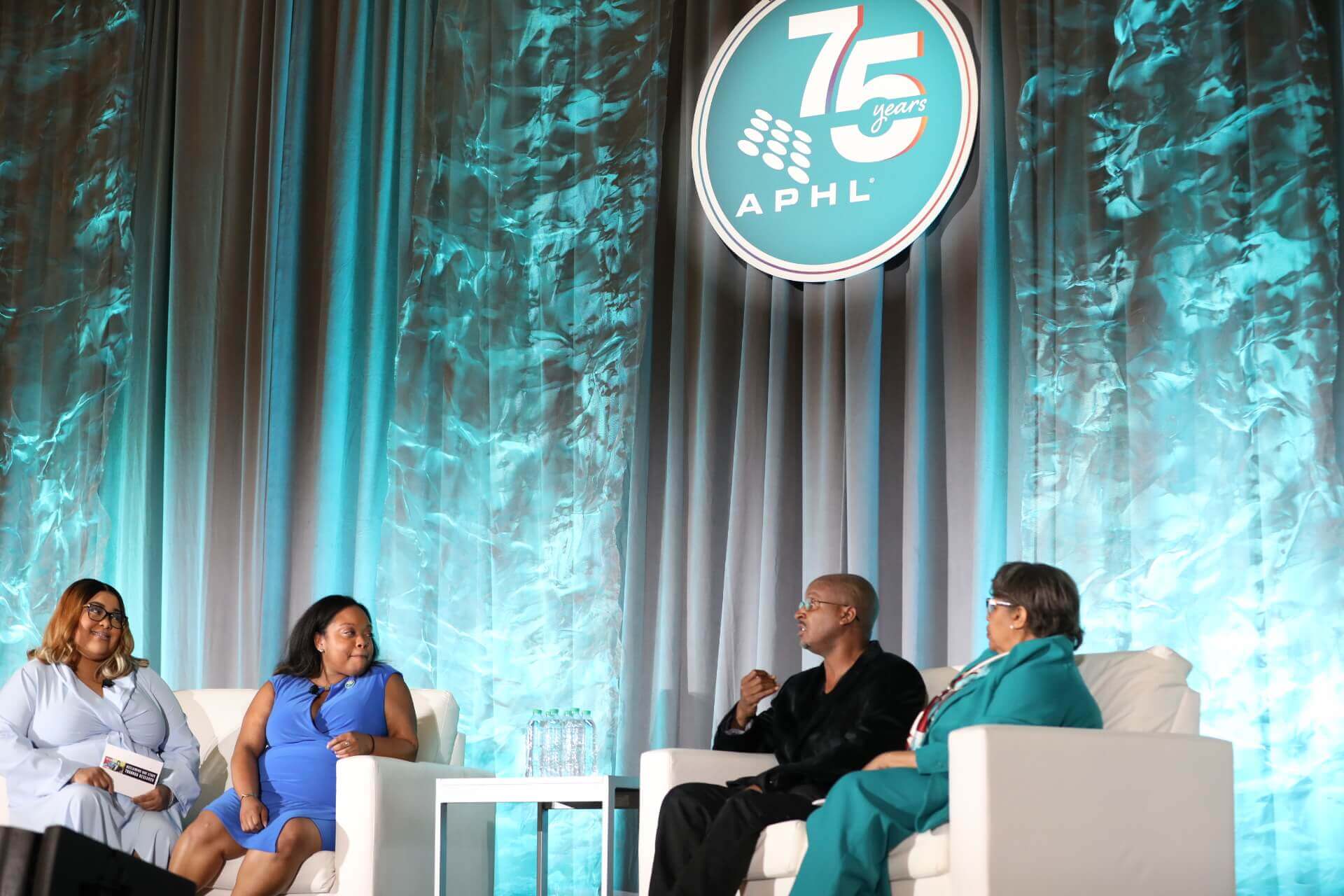
All that and more was discussed with members of Henrietta’s family at the 2026 APHL Annual Conference held in Baltimore, May 4-7. The session, “Beyond the Microscope: Henrietta Lacks—the Immortal Cells and Their Human Story,” was delivered in a question-and-answer format to a packed audience and was followed by a discussion and book signing of the bestseller The Immortal Life of Henrietta Lacks. Henrietta’s family travels around the world to raise awareness of Henrietta’s life and the medical ethics surrounding the use of her cells.

How would Henrietta have felt about having her cells used for science?
Henrietta’s great-granddaughter, Veronica Robinson, an advocate for patients’ rights, didn’t hesitate to address this question.
“We believe because of how she cared for family members, and even people who weren’t family, that she was a helper. She helped in life and even in death, and she would want to see science advance,” Robinson said. “This is the 75th year that HeLa cells have advanced science and technology, and I believe she is excited and happy because she continues a legacy and a story. Sometimes bad things happen to good people so that great things can happen to the world.”
“Henrietta was hospitable and open, and somehow that translated to her cells,” added David Lacks, Henrietta’s grandson, who works with computer information systems. “They helped and healed the world.”
Still, said Henrietta’s family, while Henrietta would have been “honored “ to see how her cells have contributed to scientific advancement, they never should have been taken without her permission.
“If I set my keys down and you pick them up without permission, that’s stealing,” Robinson pointed out. “Today, we travel as a family to reclaim Henrietta’s voice and our family’s story and to be sure that the things that happened in 1951 at the time of her death don’t continue to happen,” she added.
Henrietta’s story was told in the best-selling book and subsequent movie, The Immortal Life of Henrietta Lacks. Was she portrayed accurately?
Acknowledging that different family members have different opinions about how Henrietta was depicted, Lacks noted that “the book and movie did their jobs,” presenting Henrietta as a person, and not just a collection of cells.
Robinson elaborated, saying that her family “was a family of characters,” and the author of the book got different information from different people, not all of which was forthcoming and honest.”
Still, Robinson said, the book was successful in giving Henrietta humanity.
“That specimen, those HeLa cells in the petri dish, had an origin behind it, a person behind it, a family behind it,” Robinson said. “Sometimes we have tunnel vision in our work. And sometimes with that tunnel vision, we forget that those unidentified specimens come from a family, and we still must treat them as if that whole person is there.”
You’ve mentioned that your family is the “face of science.” What do you mean by that?
It wasn’t until 1971 that the Lacks Family discovered—by chance—that Henrietta’s cells existed and were pushing science forward. And it took another few decades for the family to realize they could either be a part of the science or be spectators. They chose the former and began partnering with the National Institutes of Health.
“We had an opportunity to make sure that the research would be ethical,” Robinson said. “That if a scientist said they were going to research the head, that it didn’t end up at the feet. That when they wrote their journal articles, Henrietta got credit for what her cells were doing. We weren’t just seat fillers in our own legacy. We decided to be a part of everything.”
“As a family, instead of being some of the last people to find things out,” Lacks said of the scientific partnership, “we’re now among the first.”
What does your family’s future legacy look like?
“Our legacy will always be tied to the cells,” Lacks explained. “To this day, they are still multiplying and dividing, 75 years after they were extracted. And they’ll be multiplying and dividing for the next 750 years and still helping the world. The cells and Henrietta are interconnected.”
Robinson pointed out that their family’s legacy is also connected to patient rights.
“Advocacy is Henrietta’s legacy at every level,” Robinson commented. “Advocacy is a choice that we must make every day. If your research doesn’t honor the people that it’s meant to serve, it shouldn’t move forward. We have to change the narrative. We have to demand transparency and transformation. Because through transparency, we can do more ethical work. And through transparency and ethical work, we will have the opportunity to move science forward for another 75 years.”