
Behind the Numbers: How Newborn Screening Programs Are Using Data to Make the Case for Better Care

Every year, millions of newborns across the United States are screened for serious, but treatable, disorders within days of birth. Test results from a dried blood spot can mean the difference between a child who thrives and one who faces lifelong complications, or worse. Newborn screening (NBS) is one of public health's quiet success stories. But for NBS staff, clinicians, policymakers and families who hold pieces of that system in their hands, the story is often hard to see.
That is changing.
The Newborn Screening Technical assistance and Evaluation Program (NewSTEPs), a program of APHL, has built a national infrastructure for NBS programs to collect and use data. Through a secure data repository, programs across the country contribute to three interconnected data streams, each telling a different part of the NBS story.
State profile dashboards are public and provide a broad view of each NBS program, including what disorders are screened, how the program is structured, screening fees and what policies are in place, helping programs and partners understand the current NBS landscape. Confirmed case dashboards bring the human dimension into focus, capturing the outcomes of newborns identified through screening and making visible the impact of a system that can be easy to take for granted.
The NewSTEPs Quality Indicator (QI) dashboards track eight standardized metrics that span the full arc of the screening process, from specimen collection to follow-up care. These include the rate of unsatisfactory specimens, the timeliness of collection, transport and reporting, and the percentage of infants lost to follow-up. Taken together, they tell a story about how well a system is working, and where it needs attention.
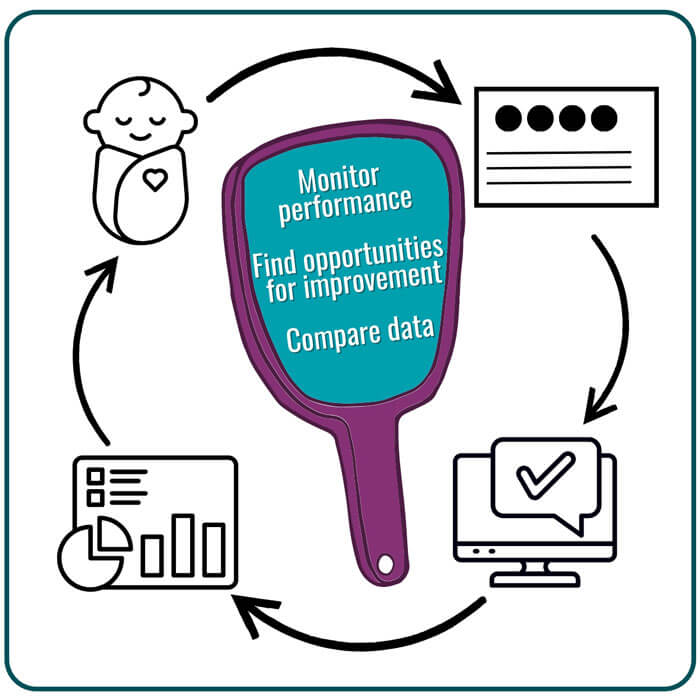
NewSTEPs did not want programs to just submit data into a black box. If programs were going to invest the time and effort to contribute, NewSTEPs wanted to give something meaningful back. The result was a suite of interactive, online dashboards that allow programs to monitor performance over time, benchmark against national and regional aggregates, and identify opportunities for improvement. This resource feels less like a reporting obligation and more like a mirror.
That visibility matters. NBS programs have used NewSTEPs dashboards to brief advisory boards, support grant applications, communicate program outcomes to partners, and advocate for resources. The data tells the story; the dashboard makes it legible.
Some programs have taken that principle directly to birthing facilities, the first link in the NBS chain. A handful of NBS programs have developed their own dashboards, drawing on NewSTEPs' QIs, to share performance data in formats that hospital staff can act on.
These tools are powerful for communicating the urgency of timeliness. When a nurse can see that a delayed specimen collection at their facility contributed to a slower result for a baby who needed one quickly, the abstract becomes concrete. The data stops being a statistic and starts being a story about a child whose care depended on timely screening.
Newborn screening is not alone in this challenge. Across public health, programs generate data that is critical, complex and chronically underleveraged as a communication tool. Dashboards and data visualizations are not just internal management tools, they are storytelling instruments that can turn a quality indicator into a case for investment, a timeliness metric into a conversation with a hospital, and a national dataset into a community's shared understanding of what is at stake. Every NBS program has a story worth telling.
For more information about NewSTEPs, visit newsteps.org.