
From Surveillance to Action: Real-time Wastewater Insights at Mass Gatherings
Authors: Andrew Nsawotebba, laboratory manager, Ministry of Health, Uganda—Department of National Health Laboratory and Diagnostic Services; Noah Hull, senior manager, Global Health; and Tara Jones-Roe, senior vice president, Sales and Marketing, Ceres Nanosciences, Inc.
Mass gatherings present a persistent challenge for public health systems. High population density, shared sanitation infrastructure and limited clinical capacity create ideal conditions for infectious disease transmission. Traditional surveillance methods—reliant on clinical reporting—often lag behind real-time spread.
A recent study from Uganda highlights a more proactive approach: real-time wastewater and environmental surveillance (WES) as both an early warning system and a trigger for immediate intervention.

A Real-World Test Case
During the 2025 Martyrs’ Day celebration in Namugongo, Uganda, more than three million people gathered over several days. Recognizing the elevated risk, Uganda’s Ministry of Health deployed a targeted WES strategy across 11 high-risk locations.
Over a four-day period, teams from the Uganda Ministry of Health Department of National Health Laboratory and Diagnostic Services collected 44 environmental samples from wastewater systems, surface water and communal sources. The goal was not only to detect pathogens, but to generate actionable insights in near real time.
Nanotrap® particles were integrated into the environmental surveillance workflow to enhance pathogen detection from wastewater and related sample types. As part of sample preparation, they enabled the capture and concentration of microbial targets prior to molecular analysis, supporting more reliable detection in complex, low-abundance settings. This contributed to improved data quality and consistency, helping ensure that surveillance outputs could effectively inform real-time public health response.
The findings underscored the value of environmental monitoring at scale. Multiple pathogens were detected across sampling sites, including:
- Vibrio cholerae (non-O1/O139)
- Shigella species
- Rotavirus
- Enterovirus
- SARS-CoV-2
- Mpox virus
Importantly, contamination levels varied significantly by location. While stagnant water and wastewater systems showed clear pathogen presence, protected sources such as official standpipes and designated “sacred” water points remained free of detectable contamination.
This level of spatial resolution enabled teams to distinguish between high- and low-risk environments, which was critical for prioritizing response efforts.
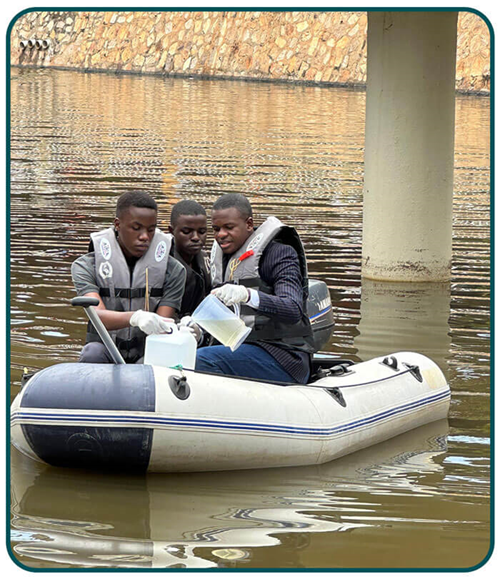
Uganda team members gather water samples for pathogen testing. Photo: Ceres Nano.
From Insight to Intervention
What sets this study apart is how quickly data translated into action. Surveillance results were communicated in real time to response teams on the ground, enabling immediate public health measures.
Interventions included:
- Drainage and chlorination of contaminated stagnant water
- Septic tank emptying in high-risk zones
- Relocation of food vendors away from contaminated areas
- Reinforcement of water, sanitation and hygiene (WASH) infrastructure
- Deployment of clinical screening stations
- Multilingual risk communication for attendees
In several instances, contamination detected near high-traffic areas triggered same-day remediation, reducing exposure risk before it could translate into clinical cases.
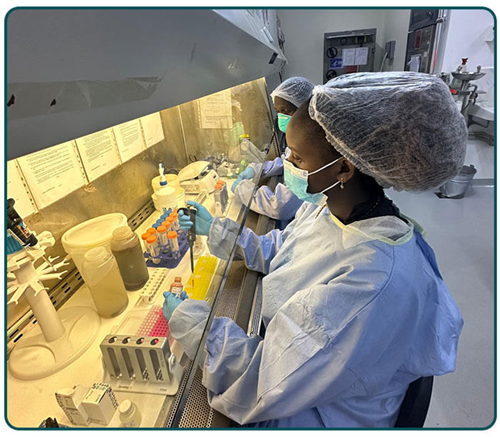
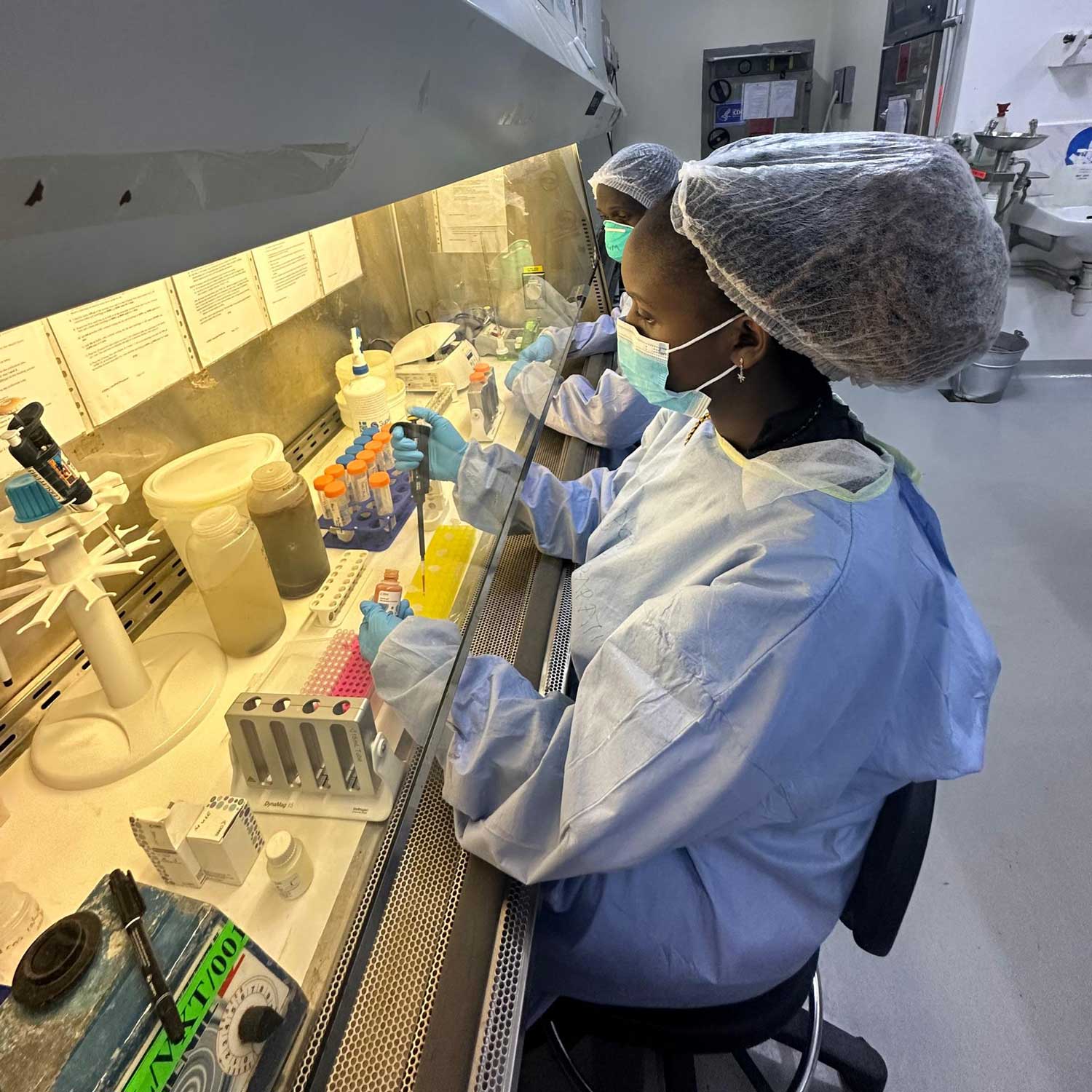
Laboratory staff process samples for pathogen determination. Photo: Ceres Nano.
Why It Matters
This work demonstrates a meaningful shift in how wastewater surveillance can be applied, moving beyond retrospective monitoring to real-time decision support.
Several key advantages emerge:
- Early warning: Detection of pathogens in the environment provides advance notice ahead of clinical case reporting.
- Targeted response: Site-specific data allows interventions to be focused where they are most needed, optimizing limited resources.
- Multi-pathogen detection: Simultaneous identification of bacterial and viral threats offers a broader understanding of public health risk.
- Operational integration: Embedding surveillance within field response systems ensures data leads directly to action.
Notably, this represents one of the first large-scale implementations of WES for a mass gathering in Sub-saharan Africa, demonstrating feasibility in a resource-constrained setting.
A Framework for Future Preparedness
As global travel and large-scale events continue to expand, the need for proactive, scalable surveillance systems is increasing. Wastewater epidemiology is uniquely positioned to meet this need—offering population-level insights without reliance on individual testing. For mass gatherings and other high-risk settings, this approach offers a practical path toward earlier detection, faster response, and ultimately, reduced disease transmission. The Uganda experience provides a replicable model: integrate environmental surveillance with rapid response infrastructure and use data to guide interventions in real time. The study illustrates a clear evolution in public health strategy. When wastewater surveillance is paired with operational response, it becomes more than a monitoring tool—it becomes a mechanism for prevention.