.png?sfvrsn=a4dc1c5f_6)
APHL Partnership Strengthens National Laboratory Sequencing Capacity
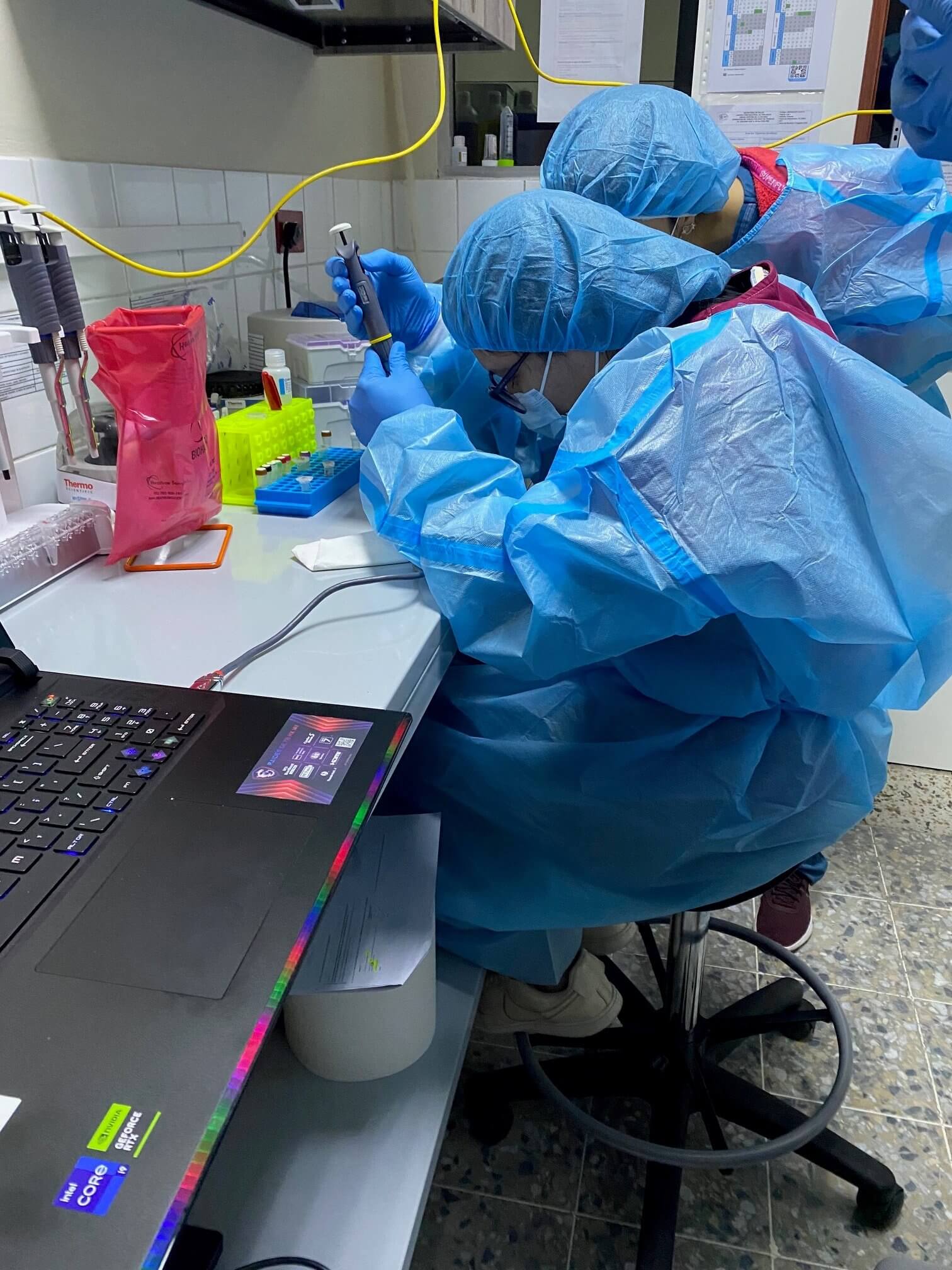
At the start of the COVID-19 pandemic, Honduras had no genetic sequencing capacity.
The country’s public health laboratories were forced to send all samples to nearby Panama for sequencing. Shipping internationally naturally resulted in delayed results—delays that only grew worse as the pandemic went on, making it harder for scientists watching the novel virus to gather useful data and mitigate its impact on the population.
Fast forward five years.
Today, with APHL’s support through the Global Public Health Data Innovation (GPHDI) initiative, the Honduras Laboratorio Nacional de Vigilancia de la Salud (National Virology Laboratory) is poised to become a regional leader in both bacterial and viral sequencing. The initiative is funded by the US Centers for Disease Control and Prevention (CDC) and the Pan American Health Organization (PAHO).

The Genomic Surveillance Project
In August 2022, a new project supported by PAHO and coordinated by Dr. Gabriela Rodriquez Segura created a sequencing space at Honduras’ Laboratorio Nacional de Vigilancia de la Salud.The laboratory sent two scientists, Drs. Soany Avilez and Karla Romero, to the Gorgas Memorial Institute in Panama for training in bioinformatics and genomic sequencing. Avilez and Romero subsequently became the first two scientists in Honduras capable of performing SARS-CoV-2 sequencing.
As the COVID-19 pandemic began to wane, the laboratory started looking for its next step. That’s where APHL stepped in.
APHL designed a training program encompassing wet lab and bioinformatics work meant to expand Honduras’ testing capabilities to include bacterial sequencing. Honduras requested guidance and training for staff at the Laboratorio Nacional de Vigilancia de la Salud on implementing bacterial sequencing on the Oxford Nanopore Technology (ONT) platform, which the laboratory had not previously done.
In May 2024, a group of scientists from various academic backgrounds gathered for the two-week training in Honduras. To prioritize a One Health approach—one that recognizes the interconnectedness of human, animal and environmental health—participants included staff at the national laboratory, representatives from academia, veterinary medicine, clinical medicine and agricultural science. Though most participants started the program with little-to-no experience in sequencing, by the end of week one they all learned bacterial sequencing and, for the first time, sequenced Salmonella spp. samples.
The second week of the training focused on analysis. Additional participants from Guatemala, Costa Rica and Panama joined in person, and participants from El Salvador and Nicaragua were invited to join remotely. A partner from Theiagen led the bioinformatics training using the Terra.Bio platform. By the end of week two, Honduran scientists analyzed bacterial data, a first for laboratory professionals in the country.
“It’s all about building networks of support within Honduras and the region,” said APHL’s Julia Pringle, PhD, MSPH, lead specialist, NGS and bioinformatics, Global Health. “That support network is a major contributor to sustainability.” APHL staff have been holding office hours for the regional participants, and Dr. Pringle noted that participants have been creating their own community of practice, regularly emailing and WhatsApp-ing each other with questions and updates.
APHL also returned to the country in July to conduct a training of trainers (TOT) session. Dr. Avilez and Dr. Romero spent three days learning how to present and train successfully on sequencing; the following day, they led and taught a full session on sequencing.
APHL’s Adolfo Lara, PhD, specialist, NGS and bioinformatics, Global Health, participated in the training and found the experience deeply satisfying.
“It was really cool to see this transformation take place,” Lara said. “We saw the people we trained become trainers, saw them rise to the occasion and flourish in the role. As one of the last countries in the region to perform sequencing, we now have people empowered to lead sequencing training.”
Lara said he didn’t know what to expect from the training, but thanks to the supportive network provided by his colleagues, he felt confident in his abilities.
“Throughout the training, my team and I along with the participants worked together troubleshooting and accomplishing the training objectives,” Lara said. “It was also the first time I was able to directly connect with other public health professionals using my Spanish skills—one of my favorite parts of the experience. I am a proponent of making science accessible on all levels,” Lara continued. “I am proud to be able to use both my science and Spanish expertise to do just that—provide trainings to strengthen laboratory systems because we are one connected world.”
What comes next?
Plans for GPHDI in 2025 include expanding the TOT program, hosting another regional workshop based on wet lab work and supporting quality assessment. Additionally, a scientist from the Honduras team will present on Honduras’ work at the PulseNet International regional training in Lima in October 2025.