
Thank You, Public Health Professionals, for Weathering the Storms

It’s been a busy year for public health professionals.
Measles cases more than doubled between 2025 and 2026, leading the US to lose its hard-fought elimination status. Nearly 13,000 people were sickened last summer in a multi-state outbreak of cyclosporiasis linked to lettuce. New World screwworm and dengue infections are on the rise in this country while Ebola, monkeypox, malaria and other dangerous diseases still rage around the world.
And that barely scratches the surface.
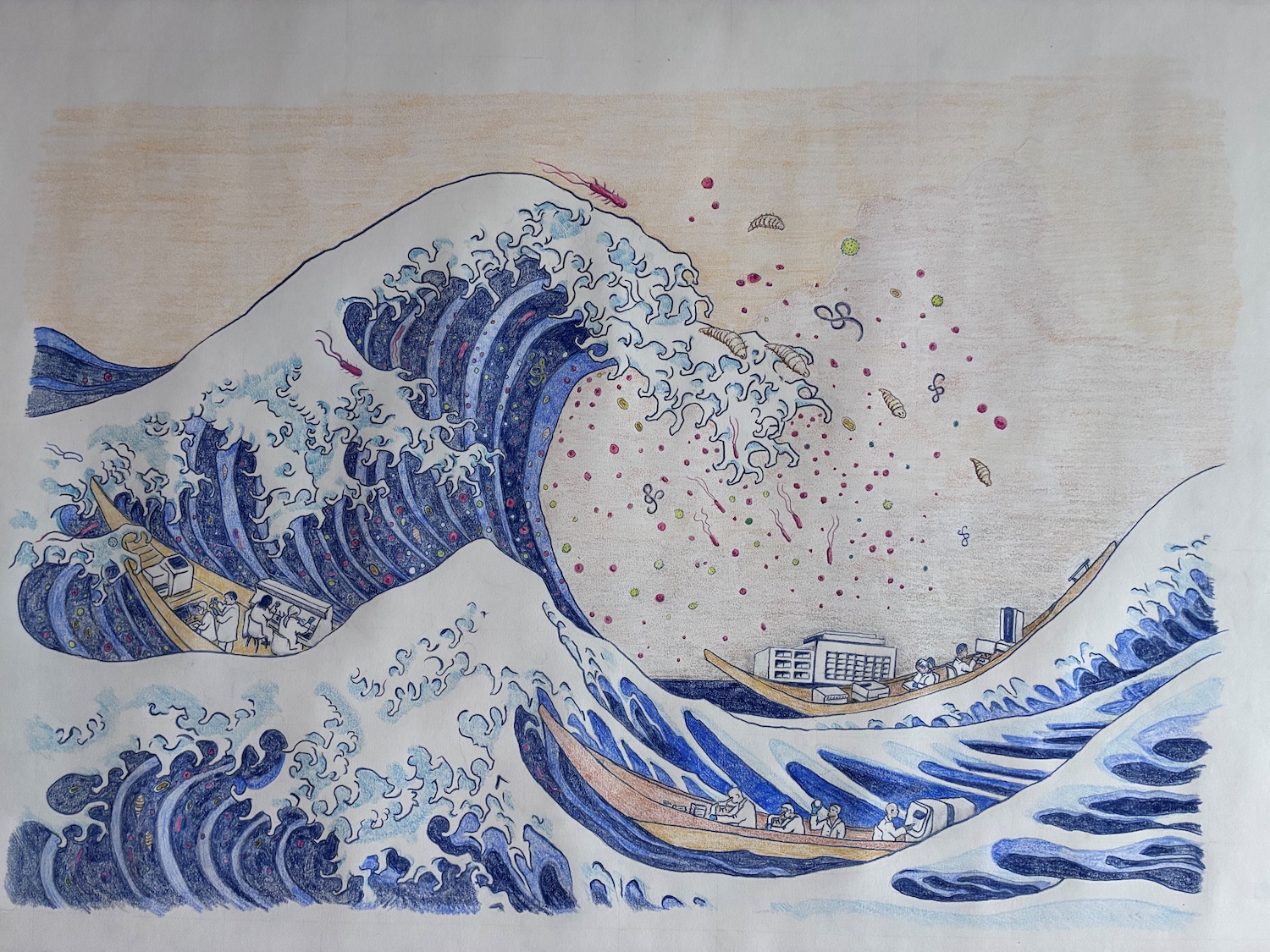
Behind every one of these stories are public health lab professionals who validate tests, ready samples, run programs, upload results and work tirelessly to protect our health. Niamh Gray, education specialist, Microbiology Unit, Public Health Laboratory Division, Texas Department of State Health Services, captured the mood well with her “Under the Wave(s) of Outbreaks” artwork, which won the grand prize in this year’s QIAGEN-sponsored Microbe Masterpieces & Chemistry Creations Art Contest held during Public Health Laboratory Appreciation Month in September. (Gray also received the 2025 grand prize for her “Laboratorian in Motion” submission.)
On the Monday before Thanksgiving, APHL, along with Research!America and other leading public health organizations, celebrates Public Health Thank You Day. In honor of the day and the dedicated public health laboratory workforce, we wanted to take a deeper dive into the inspiration behind “Under the Wave(s) of Outbreaks.” Read on to learn more about Gray’s view of 2026’s public health events and her appreciation for her colleagues and public health professionals everywhere. Despite all the storms this year, they have never wavered in their purpose or performance. Thank you from all of us at APHL!

What was your inspiration for “Under the Wave(s) of Outbreaks”?
I’ve always been fascinated by Japanese woodblock prints, and the piece I created is based on “Under the Wave off Kanagawa,” by Katsushika Holusai. I was struck by how the imagery of the choppy seas, large waves and precarious positions of the crew in their boats could represent the vulnerability of public health services to the multiple outbreaks over the last year or so. Adding microbes to the waves and ocean spray seemed apt as we were “drenched” with both outbreak and routine/surveillance specimens for a while. The power of nature can be represented in many forms!
Labs and laboratorians across the country have been weathering the onslaught of wave after wave of outbreaks and emergencies. We have continued our mission in the face of record numbers of cases and outbreaks of cyclosporiasis, salmonellosis, New World screwworm, measles, Ebola, cryptosporidiosis, norovirus, hantavirus and monkeypox.
It’s important to note that microbiology labs are not alone in experiencing the burden of increased testing and cases. All laboratory areas and laboratorians have endured the heavy lift. So, while not yet on dry land, public health laboratorians endure the seas of uncertainty in our dedication to providing data for better-targeted infectious disease interventions.
In the picture, the boats are on rough seas—but they haven’t capsized or been flooded, and the scientists continue their work. Was that imagery deliberate?
Yes, the imagery was very deliberate! The boats in Hokusai’s print are cargo vessels, designed for speed, with a large carrying capacity to bring fish and other perishables to market. And their function is symbolic of the design and functional requirements of public health labs: a need for resilience, reliability, speed, nimbleness and capacity to handle case surges. Lab results can influence policy and program planning and change lives, which are almost as valuable to quality of life as food.
Do you think the boats will reach where they’re headed in one piece?
The boats are ultimately headed to land, to deliver test results (and fish?!) to submitters, and for the crew to rest, recover, resupply and apply for grants. But they will get a little shaken about beforehand. And they knew that before they got into the boats! Such is the nature of public service.
If one of the boats takes a direct hit and gets inundated with water, the remaining boats can continue working. If they encounter a momentary bump, the team on board can revalidate the equipment, take stock and keep going. Even though they know better, the crews are not wearing life jackets, a symbol of the personal sacrifice and dedication public health workers have shown in showing up and serving through many outbreaks, epidemics and a pandemic.
Laboratory scientists are often seen as logical and “left-brained.” As a two-time QIAGEN art contest winner, what’s your thought on that?
Laboratorians are abundantly creative, and it has served public health well! Creativity has been fundamental to our resiliency in responding to funding cuts and staffing challenges over the past few years. The imagery of lab spaces on hand-built boats enhances and highlights that creativity, adaptability, dedication and teamwork.
Why are you thankful for public health, and specifically, the work of lab professionals?
I’m grateful to public health because of its fundamental role in protecting the health and well-being of our communities. I chose to work in public health for that reason (and am currently studying for a master’s degree in public health education!).
The past year in particular has demonstrated both the importance and vulnerability of our public health infrastructure and workers. In spite of that, many smart, talented and dedicated laboratorians have devoted themselves to responding to increasingly common outbreaks and emerging environmental threats, providing the evidence to inform the decision-making that protects community health.
You can see all winning entries on our website, and you can find the complete album of 2026 entries on APHL’s Facebook page.