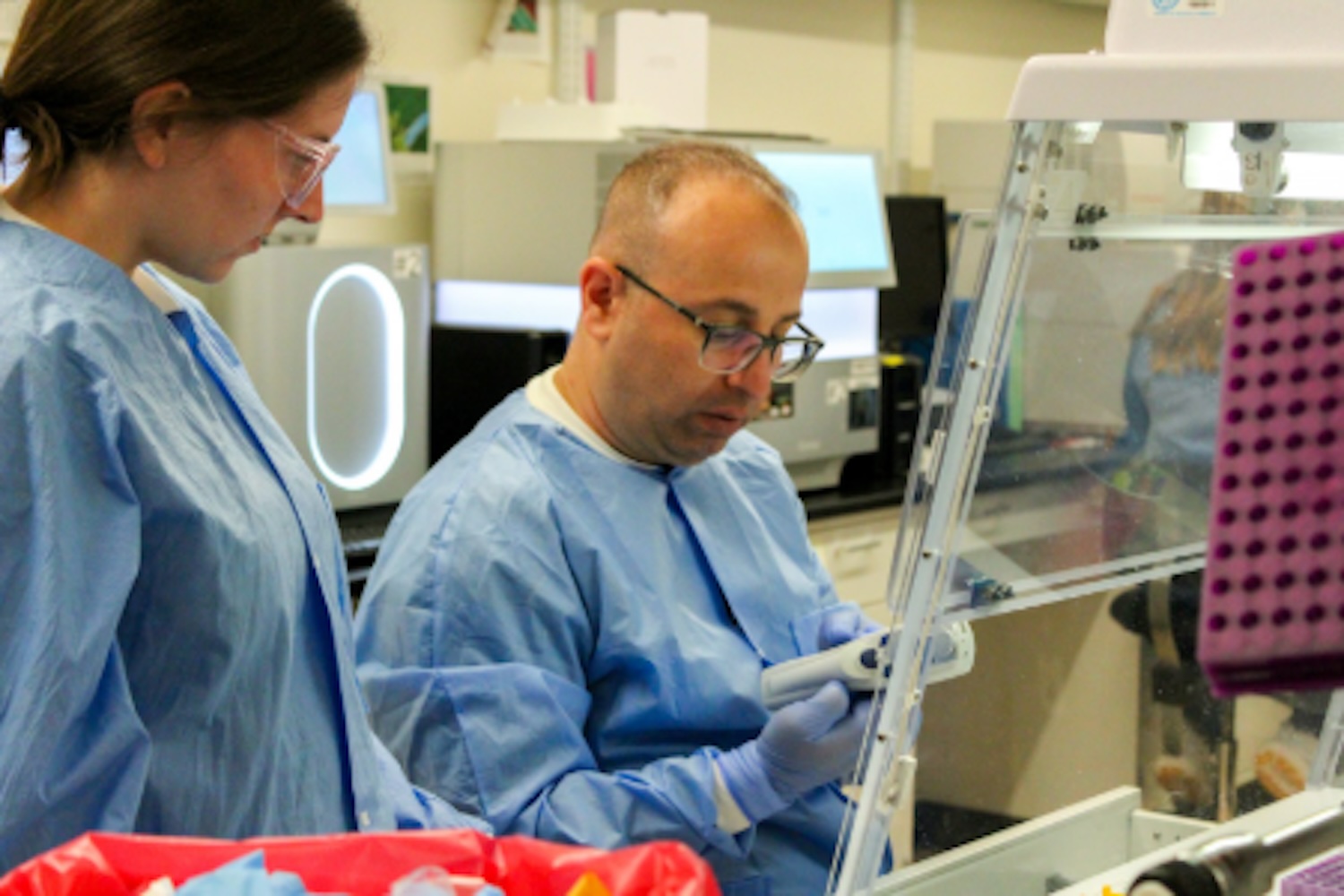
We were able to better understand their strengths as laboratorians, but also come to understand the challenges they faced."

Oct 22, 2026
Despite Challenges That Threatened to Derail Visits, Jordan and Minnesota Complete Successful Laboratory Twinning Program
When roadblocks challenged a burgeoning relationship between the Minnesota Public Health Laboratory and Jordan’s Central Public Health Laboratory (CPHL) of the Ministry of Health, APHL staff pivoted—turning an established program on its head and creating lasting ties between the laboratories.
The two laboratories are participants in APHL’s Laboratory Twinning Program, which partners US-based and international public health laboratories for mutual education. The program is funded by the US Centers for Disease Control and Prevention (CDC).
Jordan’s public health laboratory was interested in learning how to redirect genomic sequencing capacity developed during the COVID-19 pandemic to address respiratory syncytial virus (RSV); Minnesota is a worldwide leader in just that area. The two laboratories seemed perfect for each other—but the logistics of operating in a globalized world got in the way. CDC provided programmatic support by hosting meetings, coordinating with the CDC-MENA office and providing letters of support and approvals.
In recent twinning relationships, participants from the international laboratory have visited the US-based laboratory first in order to establish learning priorities. However, regional tensions meant that APHL decided to flip the visiting sequence, bringing four participants from Minnesota to Jordan in September 2025. Organizers were pleasantly surprised by how the adjusted visit worked out. Visiting the Jordan laboratory first helped Minnesota participants understand Jordan’s laboratory setup and capabilities better—information that can’t always be conveyed via an online questionnaire or survey. Participants were able to have a closer look at CPHL’s surveillance program and identified gaps in the system that could be addressed during the reciprocal visit to the Minnesota laboratory.
“By visiting the Jordan CPHL lab first, we were able to tailor the training to the team’s equipment, workflow and expertise,” said APHL senior specialist Ashley Bolding. “For example, because CPHL does not have an automated liquid handler like the Minnesota workflow uses, both teams drew on their technical expertise to manually dilute each sample and adapt the process together.”
“Working closely each day with the Jordanian team was a great educational experience,” said participant Henry Kunerth, a research scientist at the Minnesota Public Health Laboratory. “We were able to better understand their strengths as laboratorians, but also come to understand the challenges they faced.”
A sequential visit, bringing participants from Jordan’s CPHL in Amman to the Minnesota Public Health Laboratory in St. Paul, was delayed several times by global politics. During the delay, the two laboratories maintained their relationship through virtual visits. Despite visa delays and flight cancellations, ultimately three members of the Jordan team successfully visited Minnesota in late summer 2026.
“For me, the most educational part [of the reciprocal visit] was seeing how the Minnesota laboratory team applies their knowledge and experience in their daily work,” said Suhaila Khalil, head of the Molecular Unit at CPHL. “I learned a lot from the practical discussions, hands-on activities and especially from sharing our experiences and challenges with each other. It also gave me new ideas on how we can improve some of our practices in our Molecular Unit in Jordan.”
It’s been an incredibly rewarding experience, both professionally and personally.”
“My favorite part [of the twinning visits] has been witnessing and participating in the friendships that developed between the Minnesota, Jordanian and APHL teams,” said Kunerth. “I left Jordan feeling as though I’d been welcomed like family and then felt as though I had the chance to welcome family to see a part of my state. I really feel as though I’ve made lifelong friendships and witnessed others do the same. It’s been an incredibly rewarding experience, both professionally and personally.”
This experience was not only about learning new technical skills, but also about learning from each other and building a partnership that I hope will continue in the future.”
“In addition to the technical learning,” said Khalil, “I really appreciated the teamwork, the openness of the Minnesota team and the opportunity to build professional relationships. This experience was not only about learning new technical skills, but also about learning from each other and building a partnership that I hope will continue in the future.”
“I hope to have a long and fruitful continued relationship between our labs,” concluded Kunerth.
The twinning project was 100% funded with federal funds from the Association of Public Health Laboratories Cooperative Agreement number #NU2HGH000080, funded by CDC. Its contents are solely the responsibility of the authors and do not necessarily represent the official views of APHL, CDC or the United States Department of Health and Human Services.