
Bridging the Gap: How Technical Assistance is Modernizing AR Data Exchange

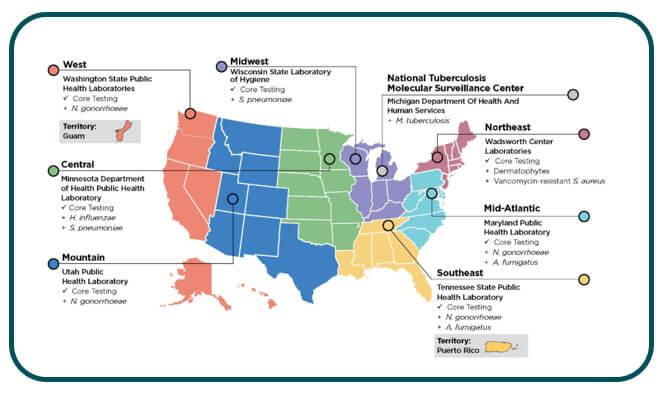
The AR Lab Network Regional Laboratories Map.
Antimicrobial resistance (AR) remains a formidable challenge for the clinical and public health community, with over 2.8 million infections and 35,000 deaths reported in the United States annually.1 For laboratory directors and informatics leads, the mandate is clear: the speed of data exchange is as critical as the accuracy of laboratory testing. In the fight against drug-resistant pathogens, the transition from manual reporting to seamless electronic data exchange is no longer a long-term goal—it is an operational necessity.
The Antimicrobial Resistance Laboratory Network (AR Lab Network) is comprised of laboratories in 50 states, as well as some cities and territories, including seven high-capacity testing and reference testing regional laboratories, and the National Tuberculosis Molecular Surveillance Center. APHL’s AR Lab Network Technical Assistance (TA) Team provides specialized expertise to leverage laboratory informatics as a force multiplier for data sharing rather than as a bottleneck.

Supporting the Laboratory Workflow
The TA Team operates at the intersection of laboratory science and information technology, providing public health laboratories with the resources needed to standardize messaging for national reporting. By working directly with laboratory subject matter experts (SMEs), the team offers targeted support in four core domains:
- Project Management & Business Analysis: Identifying the specific resources, risks, and dependencies inherent in launching or maintaining electronic messaging streams.
- Terminology Harmonization: Assisting staff in mapping local laboratory codes to nationally recognized standards (such as LOINC and SNOMED). This ensures that laboratory information management systems (LIMS) are fully interoperable with federal and local partners.
- Workflow Optimization: Analyzing current laboratory and epidemiology workflows to determine the most efficient points for data capture and transmission.
- Technical Architecture: Providing the hands-on expertise required to implement technical solutions that meet rigorous data exchange requirements.
Impact in Action: Transitioning to ETOR
A key initiative for the AR Lab Network has been supporting the implementation of the Lab Web Portal (LWP). This solution facilitates electronic test order and result (ETOR) capabilities, which directly address the inefficiencies of paper-based submissions.
For laboratories, the benefits of this transition are measurable. By reducing manual entry and paper-based workflows, laboratories have seen results turnaround times drop from seven days to 48 hours. In the context of infection control and outbreak containment, this window is a critical metric for success.
2025 Impact by the Numbers
The scale of TA support reflects a nationwide commitment to modernization (Figure 1):
| MILESTONE | ACHIEVEMENT |
| National Reach | 46 public health laboratories received TA for HL7 and CSV reporting streams. |
| System Automation | 20 public health laboratories successfully transitioned to automated HL7 reporting. |
| Infrastructure Modernization | 30 public health laboratories received guidance for complex LIMS upgrades and migrations. |
| Operational Continuity | 84 production issues were resolved through APHL-provided technical support. |
Figure 1. Milestones achieved 2025–2026.
Navigating a Resource-constrained Landscape
As laboratory departments face tightening budgets and competing informatics priorities, the TA Team provides the high-level expertise that local IT resources may not have the bandwidth to cover. Through individualized technical assistance, group cohorts and weekly office hours, the team ensures that laboratory staff gain the knowledge necessary to manage modern digital workflows.
By leveraging the AIMS Platform—a secure hub that validates and routes millions of messages monthly—the TA Team helps convert manual processes into standardized digital reality. This partnership empowers laboratory leadership to focus on high-complexity testing while securing the data infrastructure necessary to detect new resistance and protect public health.