
Evolving STI Diagnostics to Meet Public Health Needs

Authors: Richard Cullum, PhD, manager, Scientific Affairs, Abbott Molecular Diagnostics; Danijela Lucic, PhD, director, Global Scientific Affairs, Abbott Molecular Diagnostics; and Manoj Gandhi, MD, PhD, senior director, Medical and Scientific Affairs, Abbott Molecular Diagnostics
Sexually transmitted infections (STIs) continue to rise across the United States, creating ongoing challenges for public health laboratories as they work to strengthen surveillance, improve case detection and support appropriate clinical management. STIs represent a persistent and growing public health burden, with millions of new infections occurring annually and many more remaining undiagnosed. For US public health laboratories, two factors increasingly affect STI prevention and control efforts: the high prevalence of STI coinfections, and persistent gaps in access to comprehensive STI testing.
Recent multicenter evaluations of multiplex nucleic acid amplification tests (NAAT) that simultaneously detect Chlamydia trachomatis (CT), Neisseria gonorrhoeae (NG), Trichomonas vaginalis (TV) and Mycoplasma genitalium (MG) highlight the epidemiologic and clinical relevance of STI coinfections across the diverse US population.1,2 Notably, the Alinity m STI assay is currently the only FDA-cleared molecular assay that enables detection of CT, NG, TV and MG from a single test, supporting flexible and efficient test utilization when testing is clinically indicated.

More Than Just Numbers
In a prospective study of more than 3,500 men, approximately 1 in 6 individuals with an STI (15.5%) were infected with at least two STI pathogens with the majority (73%) being other than CT+NG coinfections (Figure 1).1 Similarly, among more than 3,300 women, approximately 1 in 6 STI-positive individuals (15.6%) were infected with at least two STI pathogens with an overwhelming majority (95.5%) being other than CT+NG coinfections (Figure 2).2 These data demonstrate that relying solely on CT/NG testing underestimates the true burden of STI coinfections and may leave clinically relevant coinfections undetected.
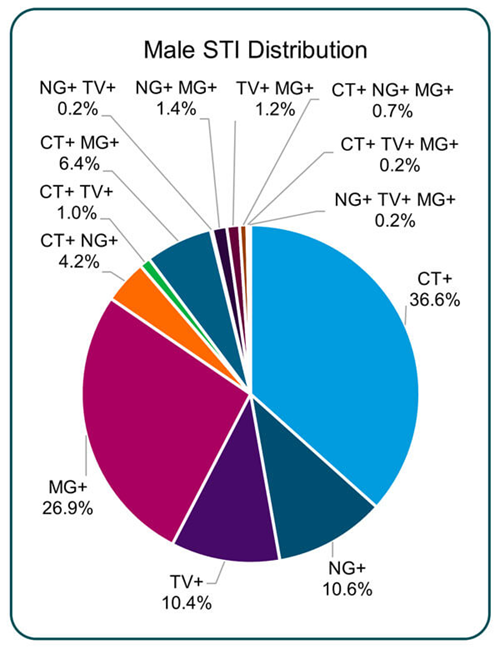
Figure 1. Distribution of STI infections and coinfections in the male study population. Adapted from Cullum et al., Sexually Transmitted Diseases, April 2026.
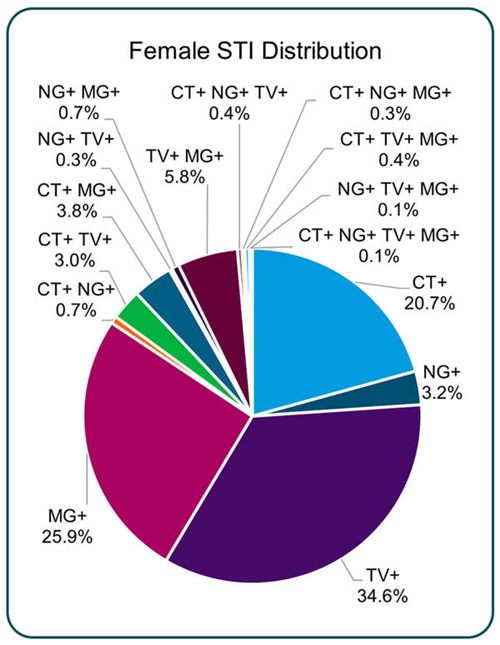
Figure 2. Distribution of STI infections and coinfections in the female study population. Adapted from Gentil et al., Sexually Transmitted Diseases, April 2026.
The clinical and public health implications of coinfections are nuanced and pathogen-specific. Many STIs are asymptomatic, and when symptoms do occur, they are often overlapping or nonspecific, complicating syndromic management. When most coinfections involve pathogens outside the traditional panel, incomplete detection can result in persistent infection, reinfection of partners, repeat clinical encounters, and increased reliance on empiric therapy. From a public health laboratory perspective, understanding the contribution of pathogens beyond CT and NG is important for surveillance, program evaluation, and informing testing algorithms while still adhering to evidence‑based guidance.
Equally important to an effective STI testing program is how and where specimens are collected. Structural barriers such as limited clinic access, stigma, transportation challenges and workforce constraints continue to limit testing uptake, particularly among populations with the highest disease burden. Patient-centered specimen
collection strategies, including in-clinic self-collection and at-home self-collection of vaginal swabs and urine specimens, offer a scalable solution that aligns with US public health priorities around access and equity. In this setting, simpli‑COLLECT™ STI is currently the only FDA‑cleared at‑home collection kit that supports 4‑in‑1 STI testing (CT/NG/TV/MG) when used with the Alinity m STI assay, providing a validated option for decentralized specimen collection.
Preparing Public Health Laboratories
For public health laboratories, these findings have direct programmatic implications. Supporting in-clinic self-collection and FDA-cleared home-collection models enables expansion of testing into nontraditional settings such as telehealth programs, community outreach initiatives and partner services programs. These approaches align with public health goals to meet patients where they are, reduce diagnostic delays, mitigate staffing constraints, and improve equity in STI prevention and care. Public health laboratories play a central role in validating specimen types, ensuring quality across decentralized collection pathways, and guiding clinicians and programs on appropriate test utilization.
As STI rates continue to rise, public health laboratory strategies must balance comprehensive detection with evidence‑based test utilization. Growing evidence on STI coinfections underscores the need for flexible, modern laboratory tools and collection models. Multiplex diagnostics paired with patient-centered specimen collection offer a path forward to strengthen surveillance, improve clinical care, support antimicrobial stewardship, and advance equitable STI prevention and control efforts in the US.
References:
- Cullum R, Gentil LG, Zhang Y, Lucic D, Van Der Pol B. Evaluation of Alinity m Sexually Transmitted Infection Assay for Simultaneous Detection of Chlamydia trachomatis, Neisseria gonorrhoeae, Trichomonas vaginalis, and Mycoplasma genitalium in Male Urine Specimens. Sex Transm Dis. 2026 Apr;53(4):245–8. doi:10.1097/OLQ.0000000000002286 PubMed PMID: 41427726; PubMed Central PMCID: PMC13007912.
- Gentil LG, Cullum R, Zhang Y, Lucic D, Van Der Pol B. Evaluation of Alinity m STI Assay for Simultaneous Detection of Chlamydia trachomatis, Neisseria gonorrhoeae, Trichomonas vaginalis, and Mycoplasma genitalium in Female Urogenital Specimens. Sex Transm Dis. 2026 Apr;53(4):249–55. doi:10.1097/OLQ.0000000000002290 PubMed PMID: 41489384; PubMed Central PMCID: PMC13007910.