
Measuring the Impact of Emergencies on Public Health Laboratory Operations and Workforce Dynamics

From 2016 to 2024, public health reports—including APHL’s Workforce Profile Survey and PH WINS—identified alarming workforce trends, such as increases in intent to leave and declines in overall job satisfaction among the public health laboratory workforce in the United States. Globally, ongoing public health emergencies and budget constraints have further strained laboratory systems, contributing to stress, burnout and workforce attrition. These workforces play a crucial role in disease detection, outbreak investigation and emergency response and—despite documented operational challenges—limited comparative analysis exists on how these pressures affect domestic and international laboratory workforces.
With the continued threat of public health emergencies and the rising uncertainty of the public health budget, APHL wanted to investigate and compare how public health laboratories in the US and globally prepare for and respond to emergencies, and how such emergencies impact laboratory operations and workforce dynamics across both contexts.

Approach
Interviews were conducted with US state public health laboratory directors across three regions1 to gather perspectives on operations, workforce capacity and emergency response. Directors represented laboratories of varying sizes and system structures, reflecting the diversity of the national public health laboratory system. To understand global laboratory experiences, we reviewed APHL Global Health program materials, including reflections and testimonials from APHL staff and laboratory leaders across multiple regions.2
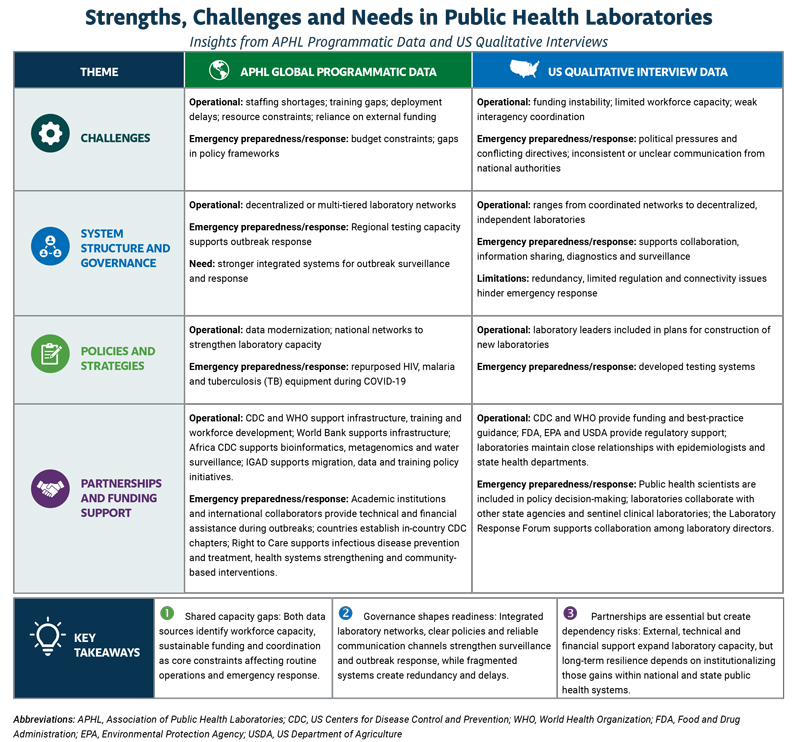
Through thematic data analysis and using the constant comparative method, APHL identified four key themes, highlighting similarities and differences across US and global settings.
Insights
The four themes—laboratory operations; system structure and governance; policies and strategies; and partnerships and funding—highlight persistent challenges alongside opportunities for sustainable operations through workforce investment and collaboration. Laboratory leaders across both contexts cited operational challenges due to funding instability, limited workforce capacity and poor interagency coordination. Staff flexibility—such as cross-training and extended hours—helped offset these pressures but was not sustainable, underscoring the need for long-term workforce investment.
Laboratory system structures and governance varied across contexts, from coordinated networks to decentralized, independent laboratories, each with strengths and limitations. Global system structures rely on regional collaboration for support, while in the US, laboratories foster support through inter-agency collaboration. While current structures meet routine needs, emerging threats and resource constraints require more adaptable, connected and resilient systems. Both US and international laboratory leaders emphasized the need for integrated systems to support surveillance and outbreak response.
Laboratory leaders across both settings provided examples of effective policies and strategic planning that strengthened operations. For example, the COVID-19 pandemic prompted adoption of automation, electronic reporting and improved data systems in US laboratories. Similarly, global laboratories advanced preparedness planning models and data modernization during the pandemic.
Multilateral partnerships and funding support have become essential to laboratory operations and outbreak response in both settings. International agencies such as the US Centers for Disease Control and Prevention (CDC) and the World Health Organization (WHO) support laboratory operations through training and policy development, funding and guidance for best practices. In global contexts, the World Bank is a major supporter of laboratory infrastructure. Regional agencies, such as Africa CDC, the Intergovernmental Authority on Development in East Africa and Right to Care Zambia, support surveillance, policy initiatives and disease prevention and treatment. In the US, federal agencies continue to provide regulatory support while laboratories build relationships with epidemiologists, state health departments, academic institutions and laboratories in the same region to support operations. These partnerships enable rapid response, including case confirmation and containment, through coordinated communication. In some cases, they have also elevated laboratory leaders into decision-making roles, helping ensure science informs policy and response.
Recommendations to Support Public Health
- Prioritize workforce development strategies, including surge staffing, cross-training and ongoing competency development to reduce strain.
- Train laboratory personnel in incident command systems and emergency management to support timely activation.
- Strengthen communication among laboratories, epidemiology units and emergency agencies to improve coordination.
- Embed laboratory expertise within emergency operations to ensure representation in planning and policy development.
- Modernize laboratory infrastructure and data systems to support advanced diagnostics and real-time surveillance.
Conclusion
Public health emergencies and funding constraints continue to expose systemic challenges, including workforce shortages, resource limitations and planning gaps that cut across continental lines and emergency contexts. Building resilient laboratory systems will require integrated surveillance, modern diagnostics and sustained workforce investment. Laboratory leaders’ experiences demonstrate that progress depends on strong governance, partnerships and long-term investment to prepare for future public health threats.
References
- Association of Public Health Laboratories. Comparison of 2016 & 2022 Laboratory Workforce Profile Surveys. QSA-Workforce-Profiles-2022vs2016.pdf. Published October 2023. Accessed October 21, 2025.
- Ahmadi SP, Ruitman HT, Sarvarzade S, Kurimski L. Generational shifts in public health laboratories. Lab Matters. 2025;Spring (1):30–31.
- Association of Public Health Laboratories. The Core Functions of Public Health Laboratories. https://www.aphl.org/aboutAPHL/publications/Documents/PHL-Core-Functions.pdf. Published March 2024. Accessed October 21, 2025.
- de Beaumont Foundation, Association of State and Territorial Health Officials. The Impact of the COVID-19 Pandemic: Rising Stress and Burnout in Public Health. https://debeaumont.org/wp-content/uploads/dlm_uploads/2022/03/Stress-and-Burnout_Infographic-01.jpg. Published 2022. Accessed November 3, 2025.