
Nov 10, 2026
Each Year, Millions of Babies Are Screened at Birth for Life-Altering—and Potentially Life-Threatening—Conditions. Meet Three of Them.
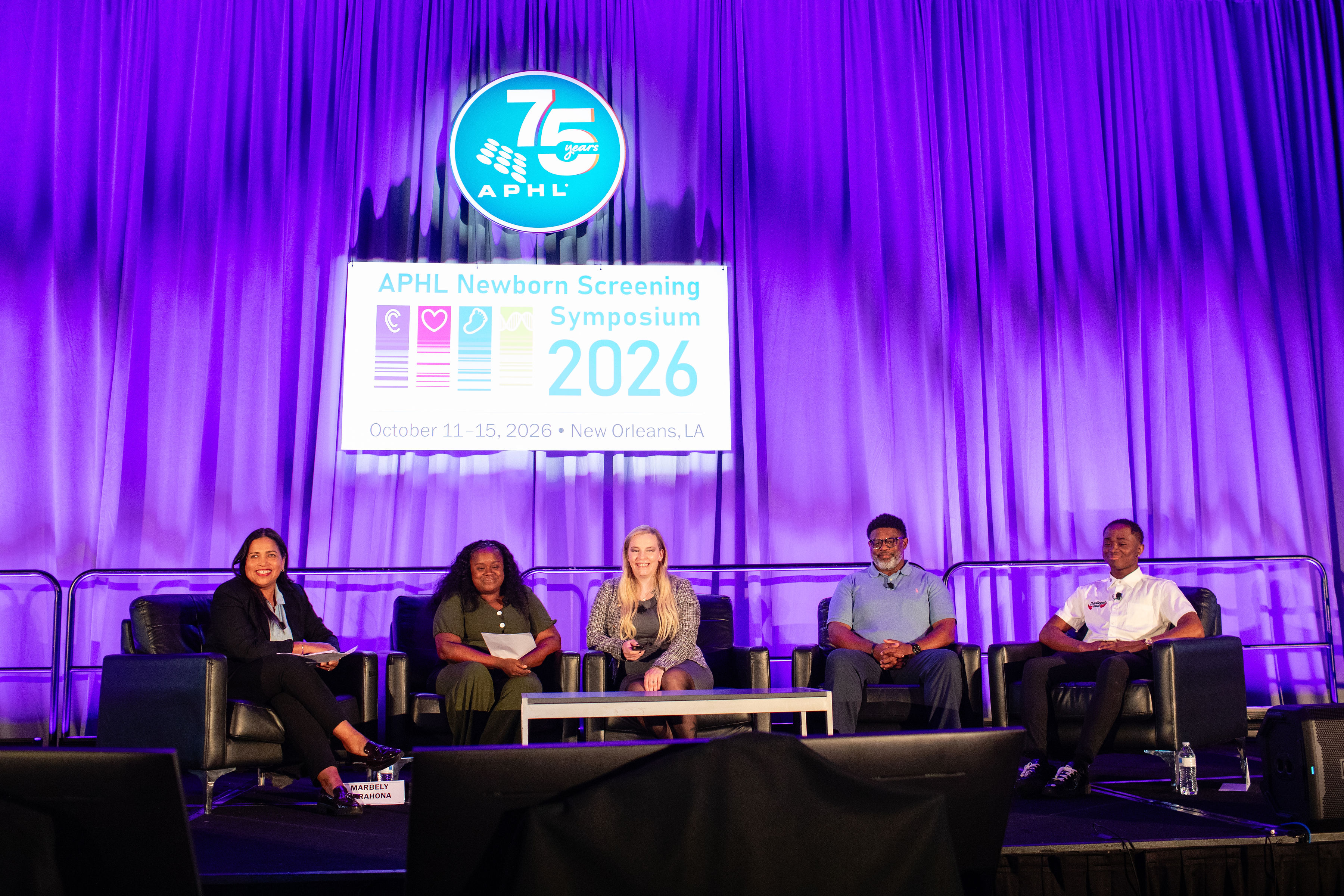
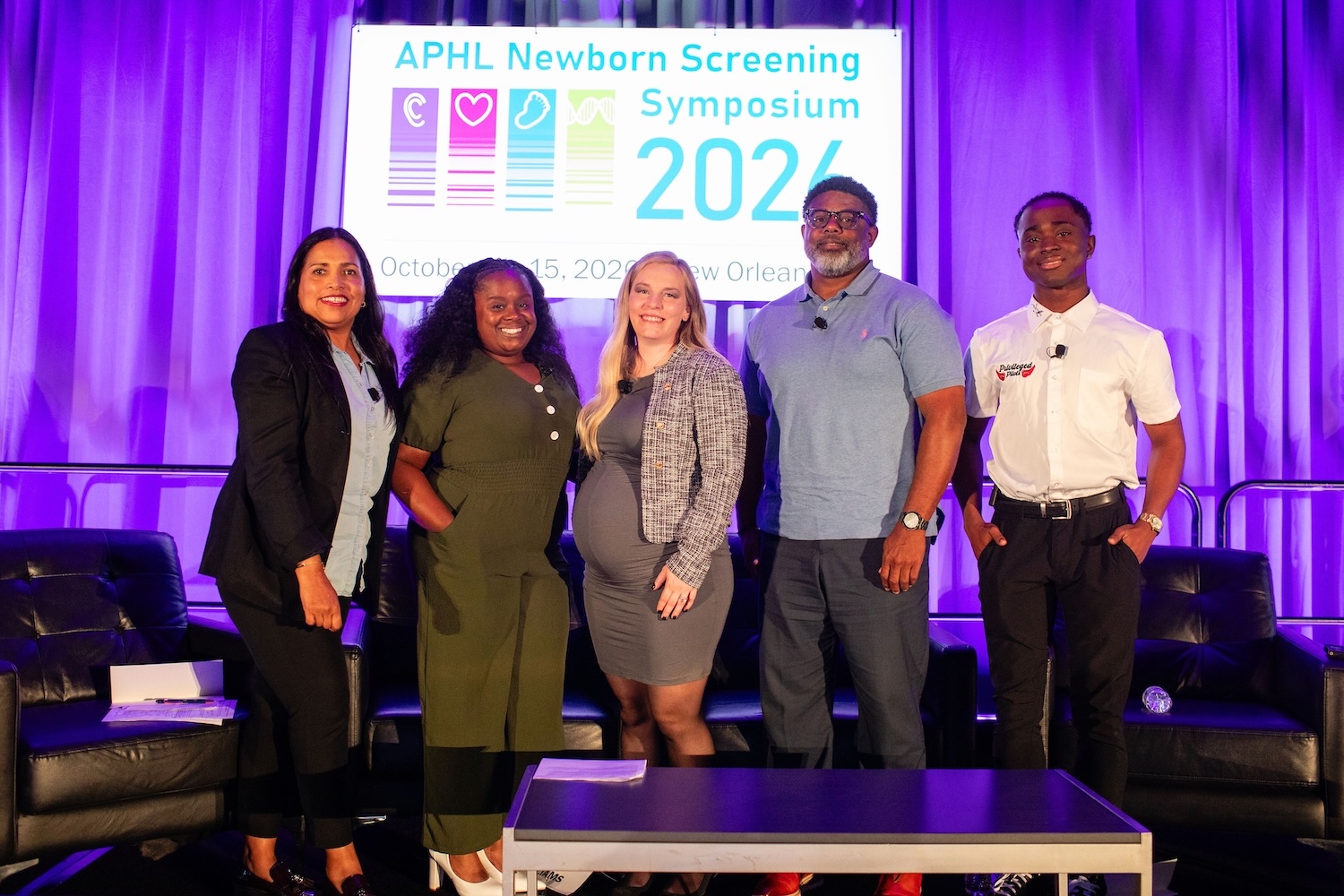
A highlight of APHL’s annual Newborn Screening Symposium, which focuses on advances in newborn screening systems and genetic testing, is a panel discussion with the individuals and families of babies whose serious-but-treatable disorders were detected within hours of birth, thanks to newborn screening.
Newborn screening, which involves taking a spot of blood from a baby’s heel and sending it to a public health lab for analysis, can identify dozens of serious disorders present at birth, as well as hearing loss and congenital heart problems. Recognizing these disorders early, often before symptoms arise, is essential to giving babies their best shot at a healthy life.
This year, the mother of a boy born with deafness and profound hearing loss, the father of a teenager with Sickle Cell Disease, and another Sickle Cell patient who became Louisiana’s first person to be functionally cured of the condition spoke about their journeys at the symposium, held in New Orleans, Louisiana, in October.
The panelists spoke not just of fear and devastation, but also of hope and resilience, of milestones reached and birthdays celebrated, of support and community, and of “surviving and thriving,” as Chadd Williams, father of the teen with Sickle Cell Disease, described it. Read on for more of their impactful stories.

“Oh, and there’s the ear thing, too”
The first to speak was Shelby Toups, a Louisiana mom to three-year-old John, diagnosed shortly after his birth with deafness in one ear and profound hearing loss in the other. Because John was born a few weeks early and had problems breathing, he was flown shortly after birth to a children’s hospital that could give him more specialized care.
As John was being prepared for transport, Shelby heard a pediatrician in the background say, “Oh, and there’s the ear thing, too.”
That’s when she learned that only one ear could be accessed during John’s newborn hearing test. His other ear was completely closed off. John was born with atresia (a missing or severely narrowed ear canal) and microtia (a missing, small or abnormally shaped external part of the ear).
“I was just a few days postpartum,” Shelby recounted. “I was not in a place to hear, ‘By the way, your son is deaf.' "
At the children’s hospital, John was found to have moderate-to-severe hearing loss in one ear and a profound loss in the other. “That was some really big news for day three of life,” Shelby said.
Nine months later, John had another hearing test and, thankfully, there was good news. While the ear with the atresia and microtia still showed little-to-no hearing, audiology exams noted a huge improvement in the hearing of his anatomically correct ear. What’s more, because his inner ear was intact, John could be fitted with a bone-anchoring hearing aid, which works by sending sound vibrations through the bones of the skull into the inner ear, bypassing the outer and middle ear completely.
To demonstrate how it works, Shelby played a short video of the hearing aid being placed around the head of a fussy baby John, who immediately calmed down upon clearly hearing—maybe for the first time—his mother’s voice. “That was a big, powerful moment,” Shelby said. Fast forward to today, and when John is wearing his hearing aid, he has almost normal hearing in the atresia/microtia ear. “That means he’s having access to full speech sounds, which is really exciting,” Shelby reported.
While the news that her baby had hearing loss was a shock, Shelby said she quickly came to terms with her new normal, thanks, in large part, to the support she received from others, including support groups, deaf educators, speech therapists, audiologists and the parents of other deaf and hard of hearing children.
“I pretty much right away embraced that my son is deaf, and this is the life we’re going to live,” she said. “I knew we would have years of more testing and possibly surgery and who knows what else, but hearing others’ stories and connecting with other families made me feel like things were going to be okay, that I wasn’t alone in this. It’s really a wonder what community does for a situation like this. It makes it feel not unfortunate and difficult. It makes it feel like this can be an exciting, new experience.”
Today, Shelby said, John is on track academically and lives a normal toddler life. He fights with his younger sister, loves to cook, listen to music, dance, watch TV and energetically run around. “He’s really living his best life,” she said. “I’m sure there are many wonderful things in his future.”
Surviving and thriving
When Chadd Williams learned his son was born with Sickle Cell Disease, he said he had to quickly learn what his child's cries meant. Was he hungry? Wet? Or in pain?
Sickle Cell Disease is an inherited condition in which the body’s red blood cells become hard and sickle shaped. This makes it hard for the cells to pass through blood vessels, causing a host of complications. People with Sickle Cell Disease can look healthy, but they can also have chronic pain, frequent infections, fatigue, problems regulating their temperature and more.
And as he grew, Chadd had to be hypervigilant. “I had to tell him he couldn't swim, he couldn’t play in the snow without precautions,” he said. “You basically have to put a bubble around your kid, and that’s hard to do because you just want them to enjoy their childhood.”
Having access to top-notch medical care—especially medical professionals who believe a patient when they say they’re in pain—and engaging with a support group have been essential to navigating the disease, said Chadd. “My son is growing up in a community that is saying, ‘Hey, we’re okay. Though we have this disease, we can survive and thrive—together, ' " he commented.
Now that his son is 19, Chadd said he’s trying to “take my hand off the bicycle.” But letting go can be hard. “One of my biggest challenges as he’s going into adulthood is getting him to realize that he’s not always going to have Dad here to say, ‘Hey, did you take your medication? Have you stayed hydrated? Do you have a sweater?’ That’s the difficult part of being the parent of a young adult with Sickle Cell Disease.”
Chadd finished his talk by praising the work of healthcare and newborn screening professionals. “Thank you for advocating for diseases that your children may not even have,” he said. “I commend you and thank you for your efforts and fighting this fight.”
The sky’s the limit
Last to speak was Daniel Cressy, a 23-year-old aspiring pilot who, thanks to gene therapy, has recently become Louisiana’s first person functionally cured of Sickle Cell Disease. When it comes to Sickle Cell Disease, a functional cure means that while a patient’s red blood cells have been genetically modified so they don’t sickle, the mutation that causes the sickle cell still exists.
“I’m thankful for this therapy,” Daniel said. “Receiving it has been a privilege.”
Daniel credits his pursuit of aviation with leading him to gene therapy, as conditions like Sickle Cell Disease can be a roadblock to individuals looking to meet the medical requirements necessary to obtain a pilot's license. For two years, Daniel endured stem cell collections, transfusions, intense chemotherapy, lengthy hospital stays and insurance battles.
“This story is a story of breaking barriers and making history,” said Daniel, who was recently cleared by the FAA to continue his pilot training. “We changed the story from impossible to I’mpossible. During the journey, there were many times I wanted to give up. But I had a mission and a purpose.”
Daniel, who cofounded the nonprofit Privileged Pilots, said he once thought of his disease as a curse because it stood in the way of his dream of becoming a pilot. “But it really turned out to be a big blessing,” he noted. “I was able to overcome it and prove to the world that this will not define me and what I can do in life.”