
“I know things are hard right now, with the economy and government shutdown, and that must be a strain on your already difficult jobs. So please have families like mine in mind when you wonder why am I here? What am I doing? What’s happening in the world?’ Rosalie is why.”
.png?sfvrsn=a4dc1c5f_6)
Oct 9, 2025
3 Moms Share Their Experiences with Newborn Screening—and the Life-Changing Impact It’s Had on Their Families
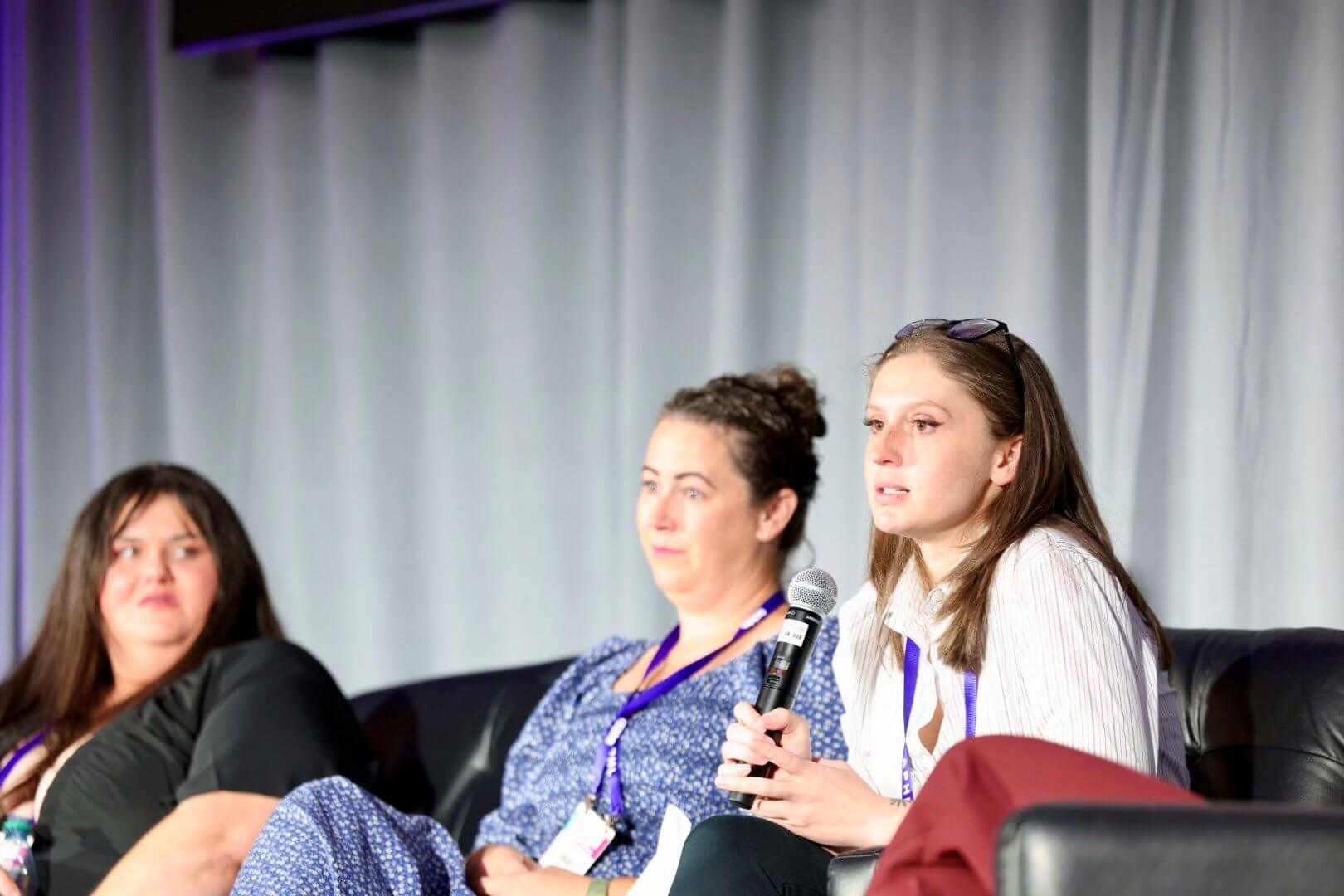
Three mothers took the stage at the 2025 APHL Newborn Screening Symposium, sharing stories about how newborn screening—or the lack of it, in one case—changed their lives forever.
The symposium, which focuses on advances in newborn screening and genetic testing, was held in Providence, RI, October 5-9.
At some points speaking through tears, the women gave the audience a glimpse into their “lived experiences” caring for children with genetic disorders—the kind of disorders often picked up by routine newborn screening.
Every year millions of babies in this country undergo newborn screening hours to days after birth. The screening detects certain genetic, endocrine and metabolic disorders, as well as hearing loss and congenital heart defects. The earlier these conditions are diagnosed, the earlier children can start treatment and interventions, thus helping to prevent death and disabilities, giving them the healthiest start to life.
“Make sure you take a photo of her before she goes in. It may be the last one you get.” Giorgi’s Story
Giorgi Segama had a healthy pregnancy, but just hours after her daughter Rosalie’s birth in October 2022, it became clear that something wasn’t quite right. Newborn screening indicated Rosalie had a congenital heart defect, even though a cardiac sonogram performed while Giorgi was pregnant showed no developing abnormalities.
“There’s this joy of giving birth and then there’s a discussion about whether my baby is stable enough to be transported to a children’s hospital. It was overwhelming,” Giorgi said.
In the weeks that passed, Rosalie was diagnosed with pulmonary artery stenosis (a narrowing of arteries that carry blood to the lungs), an aortic aneurysm (a bulging in the wall of the main artery that carries blood to the heart and the rest of the body), atrial septal defect (a hole in the wall that separates the two upper chambers of the heart) and Noonan Syndrome (a genetic disease that causes physical and developmental abnormalities). At about a year old, Rosalie underwent open heart surgery to correct her abnormalities. One relative told Giorgi to take pictures of her daughter before she went in for the procedure. “It could be the last one you get,” the relative said.
The surgery was a success. Today Rosalie is a thriving three-year-old, and her mother has all the photos to prove it.
“Rosalie is strong and imaginative and beautiful,” commented Giorgi. “But most importantly, she’s healthy. And that’s because of people like you. I know things are hard right now, with the economy and government shutdown, and that must be a strain on your already difficult jobs. So please have families like mine in mind when you wonder why am I here? What am I doing? What’s happening in the world?’ Rosalie is why. These other panelists’ babies are why. I want to say thank you to every one of you, because without people like you who are passionate and caring, we wouldn’t have the phenomenal outcomes many of us are lucky to get.”
“When you lose your parents, they call you an orphan. When you lose your husband, they call you a widow. But when you lose a child, there is no word for it.” Lindsey’s story
Avery Coupe was born seemingly healthy in Rhode Island in 2018. But at a few months old, when she wasn’t reaching milestones, wasn’t feeding well and was becoming increasingly irritable, her parents became concerned.
“We had a few hospital stays that spring,” Avery’s mom Lindsey recounted, “and the diagnosis was ‘failure to thrive.’ After our second failure to thrive diagnosis, our pediatrician noticed that Avery just wasn’t the same baby that she was the week before. Her hands were tight. She didn’t have the same muscle tone as the week before.”
Lindsey took Avery to a neurologist who suspected she had spinal muscular atrophy (SMA). “I spent weeks trying to figure out how I was going to afford the $2 million the treatment costs,” Lindsey remembered. “But at least there was a treatment.”
Avery underwent a muscle biopsy to confirm the diagnosis, but the results were negative. She was referred to a geneticist, who, after more testing, determined Avery had Krabbe Disease, a rare and life-threatening condition that affects the nervous system.
“They had invited a palliative care doctor to the meeting when we got the diagnosis,” said Lindsey, her voice cracking. “I thought SMA was the end of the world, but it turns out Krabbe Disease was going to be worse.”
“They had invited a palliative care doctor to the meeting when we got the diagnosis,” said Lindsey, her voice cracking. “I thought SMA was the end of the world, but it turns out Krabbe Disease was going to be worse.”
Sadly, because Avery was already displaying symptoms of the disease, doctors told Lindsey there was little they could do to help her. To have a shot at life, Avery needed treatment before symptoms started.
“Krabbe Disease progresses silently in the first weeks and months of life,” Lindsey explained. “But the only way to identify Krabbe Disease before symptoms start would be through newborn screening [most states, including Rhode Island, do not test for Krabbe Disease]. If she had been screened in the first month of life, she could have received treatment and she could be with us here today.”
Avery lived 18 months
Quoting from a TV show she watches frequently, Lindsey said, “This FBI agent was talking, and he said, ‘When you lose your parents, they call you an orphan. When you lose your husband, they call you a widow. But when you lose a child, there’s no word for it. That’s how bad it is.’ I hope Avery’s story, that our story, is the last one in Rhode Island,” she added.
“I got judgments for bringing my daughter into the world knowing she could be sick. But she was meant to be with me, and I was going to take care of her no matter the outcome.” Faith’s story
As far as Faith Porter knew, she wasn’t a carrier for any genetic diseases, but when she was just a few months pregnant with her daughter Haven, she decided to undergo genetic testing.
The tests revealed she had the genetic code for cystic fibrosis (a genetic disorder that affects the lungs and other organs). Her baby’s father was also tested—and he, too, was determined to be a carrier for the disorder. The silver lining? “The genetic code I carried was different from the one Haven’s father carried, which meant she probably wouldn’t have cystic fibrosis as badly as some.”
There was also a chance that Haven wouldn’t have the disease at all, but those chances were slim. There was a 90% chance she’d have the disease, a 10% chance she wouldn’t.
Faith clung to hope.
“I got a lot of judgments about bringing my daughter into the world knowing she could be sick,” Faith said. “But I knew that regardless of her being sick, she was meant to be with me, and I was going to take care of her no matter what the outcome was.”
When Avery was born in August 2024, she seemed fine.
“She had a little bit of a problem transitioning to breathing on her own, but she was perfect,” Faith said. “I was thinking everyone was preparing me for the worst, but nothing’s wrong. But once she had her newborn screening—and luckily cystic fibrosis is one of the things they test for in Rhode Island—that began our journey of appointments and medications and treatments.”
“Her doctors have never seen a cystic fibrosis patient who is doing as well as she is. And for that I am very thankful.”
Today, Haven is a “regular toddler,” Faith commented. “Her doctors have never seen a cystic fibrosis patient who is doing as well as she is. And for that I am very thankful. I prepared for the worst during my pregnancy but hoped for the best, and now we are living the best life and she’s as healthy as can be. I’m just so happy it was caught early, and we can go on living our lives and making sure Haven gets everything she needs.”