By Donna Campisano, specialist, Communications, APHL
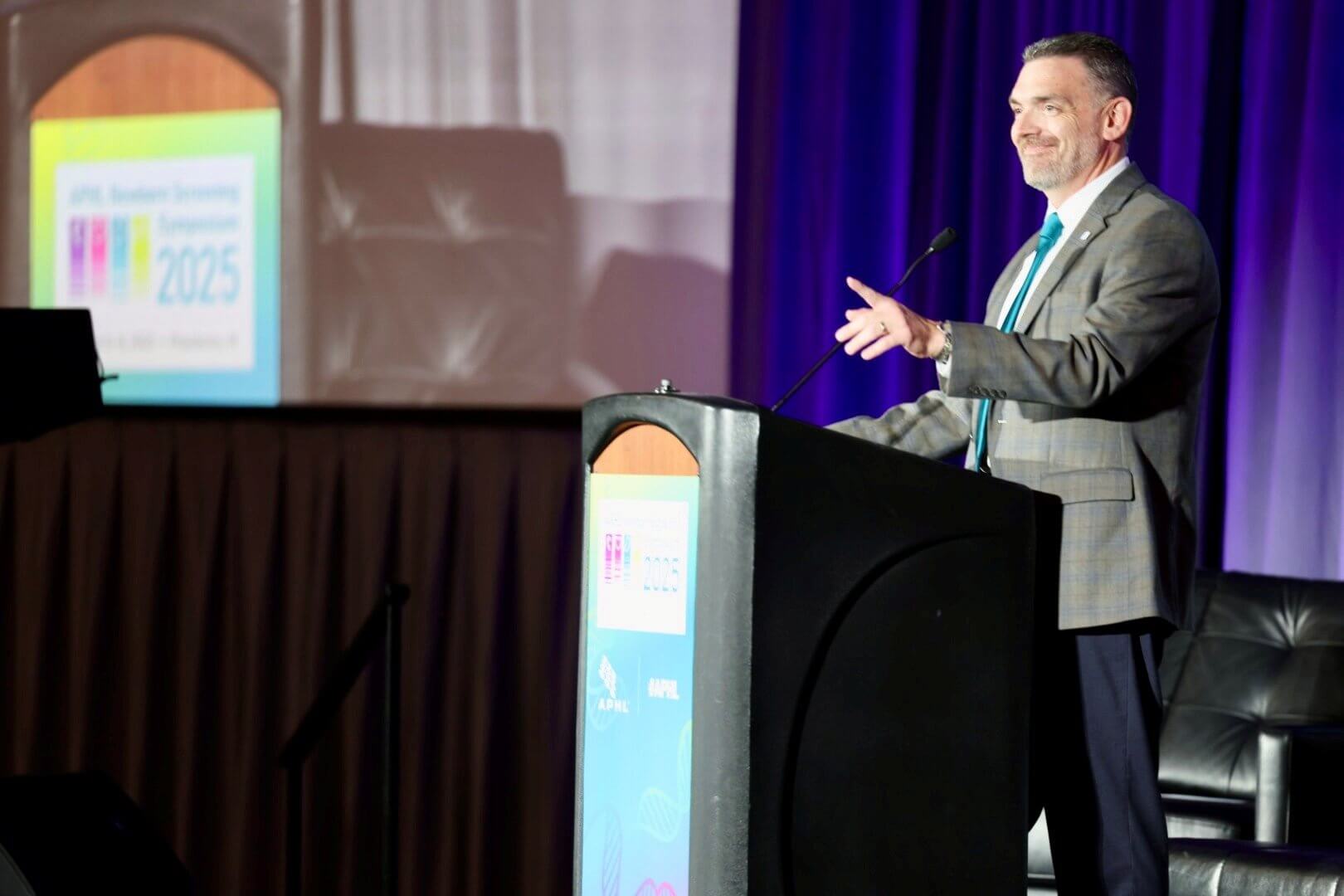
Telling stories that increase public health’s visibility and practicing mental fitness were two themes that ran through the 2025 APHL Newborn Screening Symposium keynote address. The symposium was held in Providence, Rhode Island, October 5-9.
Good stories with good science
Brian Castrucci, DrPH, president and CEO of the de Beaumont Foundation, stressed to the packed ballroom the importance of clear, concise messaging when it comes to conveying the impact of public health and newborn screening.
“If someone asked you what you do, how many words would it take for you to say it?” Castrucci asked the crowd. “It shouldn’t be more than five, and it’s as simple as, ‘I save and improve lives.’ It shouldn’t be technical. It shouldn’t be scientific. Every day you get up and go to work and quietly save lives.”
Castrucci urged the audience to “leverage their power” as champions.
“The future of public health needs you more now than ever. And not just as a scientist or technician, but as a champion.”
“You’re not just about blood spots and heel pricks,” he said. “You’re eliminating suffering before it begins. Every time a newborn screening catches a disorder, you change the future. The future of public health needs you more now than ever. And not just as a scientist or technician, but as a champion. If we don’t tell the public health stories, someone else will. And they may not do a good job of it.”
Crafting the right message—and choosing the right messenger—are key to telling the stories, Castrucci noted.
“The work you do is hidden, but the lives you save are not. You have a story to tell here. Bring it forward.”
“Newborn screening is something that should be a rallying point for every American,” Castrucci said. “No one wants to see their kids suffer. This is something we need to grab onto. We don’t need jargon. We need stories. Stories are sticky in a way that data is not. Visibility isn’t vanity. It’s survival.”
While public health is often seen as a silent science, protecting people when they don’t even know they need protection, Castrucci said it’s time to get loud.
“Would you buy a product that had no advertising? Would you buy a car you never heard of? If you have good stories with good science, you have the power to create change. And with the right messenger, you can influence. Keep the message simple. Keep it personal. And partner with the right people—community, business and religious leaders. Speak in public forums. Use social media. Advocate in your own way. The work you do is hidden, but the lives you save are not. You have a story to tell here. Bring it forward.”
From burnout to resilience
Between staffing shortages, retention issues and funding cuts, public health professionals are feeling spent and stressed. Kris Liebau, founder of Action and Ease Coaching addressed those feelings—and what to do about them—in her keynote remarks.
And pausing to rest, reset and even celebrate are essential, she said.
”As people, we’re not designed to run 100% of the time.”
“Even in NASCAR races, drivers need to make pit stops,” Liebau said. “They need to get gas. They need to change tires and wipe rubber off the windshield. Even though we’re really passionate about our work, we also need to take those opportunities to pause. As people, we’re not designed to run 100% of the time.”
Pausing, said Liebau, is crucial to self-awareness. And when we’re self-aware—about our decisions, about how stress is making our bodies feel—we can more easily pivot, reset and move forward with renewed clarity and creativity.
The final speaker, Scott Shone, PhD, president of the APHL Board of Directors and director of the North Carolina State Laboratory of Public Health, also stressed the importance of self-care—and the power of positivity—to reduce burnout, especially in a field like public health where much of the work goes unrecognized.
“Take 30 seconds to thank or acknowledge someone, because it really fills the bucket.”
“Everybody has an invisible bucket that we carry around with us,” Shone said. “And it holds all the good thoughts and feelings we have about ourselves. And when you say positive things to someone else, it fills their bucket. And it fills yours. Take 30 seconds to thank or acknowledge someone, because it really fills the bucket. Sometimes we all say, ‘What the heck am I doing here?’ And that’s OK. The challenge is to remind yourself of what fills your bucket.”
Share:
subscribe:
submission received:
Thank you for subscribing!
Thanks for subscribing to our blog!
We Value Your Privacy
We use cookies to enhance your browsing experience. By clicking "Accept", you consent to our use of cookies. Read our privacy policy for more.
.png?sfvrsn=a4dc1c5f_6)