.png?sfvrsn=a4dc1c5f_6)
4 Public Health Laboratory Professionals Answer 4 Questions About APHL’s Twinning Initiative
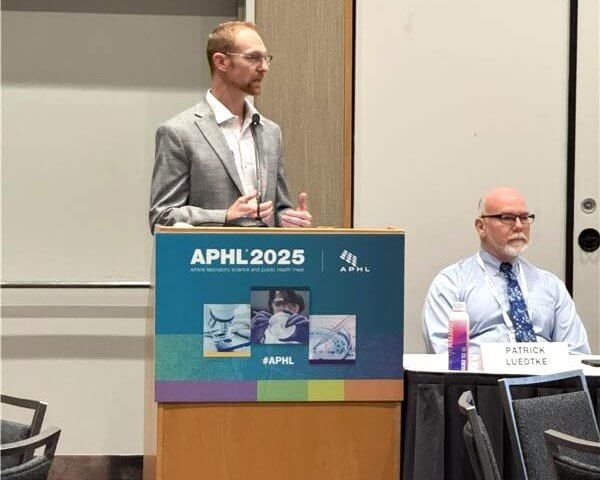
Four public health laboratory directors convened a session at APHL’s 2025 Annual Conference held in Portland, Oregon, May 5-8 to discuss their experiences twinning with public health labs throughout the world.
APHL’s Laboratory Twinning Initiative pairs US state and local public health laboratories with national reference laboratories in other countries. The laboratories, who are paired based on expertise and need, work together in a peer-to-peer relationship that increases the knowledge of both parties and builds a global public health network. The initiative has historically been funded by several sources, including US Centers for Disease Control and Prevention (CDC) and the World Health Organization. The labs learn from each other to strengthen and enhance laboratory capacity.
“Twinning is different than mentorship,” said APHL’s Matthew McCarroll, moderator of the panel. “It’s a bi-directional, mutually beneficial partnership. It’s the sharing of information, experiences, challenges, successes and lessons learned.”
The panel answered questions from both McCarroll as well as a diverse and international audience. Panelists described what they have provided to their partner labs and—perhaps more importantly—what they have gained. Here, some highlights.

Q: Is there anything that would prevent your lab from getting involved in a twinning program?
A: “Fear of the unknown,” answered Sameer Sakallah, PhD, of the Kansas Public Health Laboratory, who acknowledged his lab is toying with the idea of twinning but has not yet committed. That fear, Sakallah said, stems from concerns about safety and expectations. “But it’s important to understand that you’re not expected to turn a very basic lab into a top-notch CDC-style lab, and you’re not going to be sent anywhere deemed dangerous.”
McCarroll picked up on that theme, telling the audience that APHL is fully committed to travelers’ safety and well-being.
“We’re here to assist with visas and passports,” McCarroll said. “We also supply travelers’ insurance, help with medical and security-related events, provide travel and security risk-management online courses, offer pre-travel briefs and more. The most important thing to remember is that you are not alone. We provide support and assistance as needed.”
Another concern is the language barrier, and although interpreters are often available, panelists noted that language has never been a huge stumbling block.
“We communicate through science, through the use of instruments and procedures,” said Joseph Reed, PhD, of the Wyoming Public Health Laboratory, which twins with the Oman Ministry of Health Central Public Health Laboratories. “Through our twinning experience, we saw our staff and the staff in Oman open up to each other and share their stories, and what we found is that those stories are not all that different from our own. We all struggle to transport samples to our lab at the right temperature, for example, or to get the lab director to buy that shiny new piece of equipment.”
Q. Is twinning a big time/resource commitment?
A: “It hasn’t been for us,” said Sarah Vetter, PhD, of the Minnesota Public Health Laboratory who is twinning with Jordan. “The biggest lift has probably been in getting training materials, but we’ve leveraged what we already have. We’ve been taking the tools and materials we have and looking at them through a different lens to see if they’ll work for the lab we’re twinning with.”
Q: How do you decide which staff will travel to the country you’re twinning with?
A: “That will depend, at least partially, on the needs of the country,” said Patrick Luedtke, MD, director of the Oregon Public Health Laboratory, who worked on a past twinning project with Barbados when he was a laboratory director in Utah. “In Barbados, they rely heavily on the cruise industry, and they really focus on the quality of their water, so we looked for people with that expertise. But we also looked at who could grow internally from the experience. Because this isn’t just about teaching people in other countries. There’s internal growth, too.”
Q: What are some of the advantages of participating in twinning?
A: “In my lab, it was being able to give my laboratorians a foundational understanding of the scientific processes they were doing,” Reed commented. “There’s something to be said for challenging our staff to know their processes, especially complex scientific processes, and be able to teach them to others. For us, the biggest benefit has been the way the initiative has helped us develop our staff into leaders.”