.png?sfvrsn=a4dc1c5f_6)
APHL’s 2024 Newborn Screening Symposium Addresses Workforce Recruitment and Retainment in Keynote Session
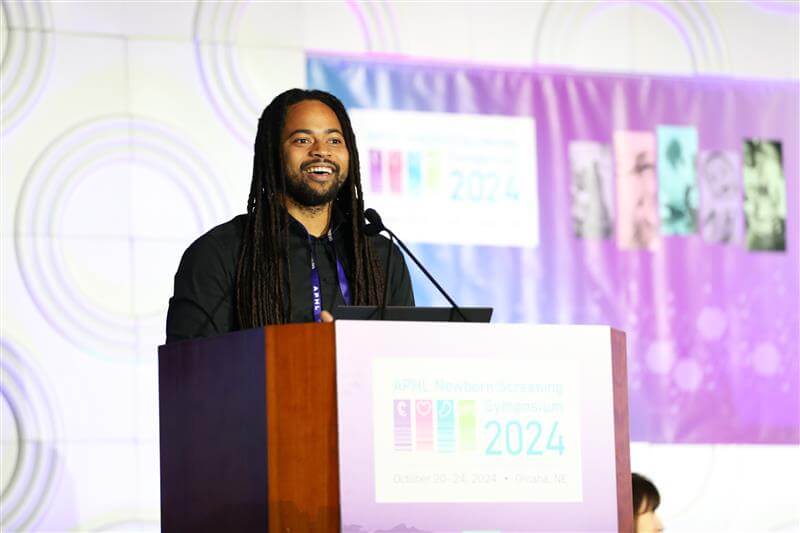
Public health has a personnel problem.
Since the COVID-19 pandemic, the public health workforce has shrunk dramatically. It’s projected that there will be a shortage of 100,000 public health professionals by 2025, up from 80,000 in 2021.
To perform even basic public health core services, the public health community needs a robust and diverse workforce that operates in a supportive and inclusive environment. The 2024 APHL Newborn Symposium keynote session addressed the faltering public health workforce and provided a road map on how to build it up.
The event, sponsored by APHL, the Nebraska Department of Health and Human Services and the International Society for Neonatal Screening, was held October 20-24 in Omaha, Nebraska. The symposium addressed state, national and international newborn screening, genetic testing and policy issues important to public health newborn screening systems, including workforce development.
“Public health is, of course, service,” said Timothy Tesmer, MD, chief medical officer of the Division of Public Health for the Nebraska Department of Health and Human Services, in his opening remarks. “But it’s also energy, dedication and professionalism. It’s being proactive and reactive. I’m just amazed at what happens in public health, and I want the public to know how vital this profession is.”
Engaging the next generation of public health professionals
After a welcome by Tesmer, Omari Richins, MPH, took to the podium. Richins is the founder of The Public Health Millennial, an organization that offers information and resources to those interested in pursuing careers in public health.
Richins started his remarks by reporting on survey results from APHL’s 2024 Laboratory Workforce Profile showing that 24% of the public health workforce intends to leave their jobs within two years and 39% note they will be departing within four years. Two of the top reasons for leaving were salary and lack of a career path.
To counteract the great withdrawal from public health, Richins emphasized the need for relationship building, and that includes, he said, promoting people who not only have technical skills but also people skills. It also includes identifying and actively working against biases, whether they’re focused on age, race, gender, etc.
Richins also emphasized the need for communication, mentoring and collaboration, especially, he said, since 75% of the global workforce will be millennials by 2025 and one-third of the global workforce will be comprised of Gen Z-ers by 2031.
“The workforce is getting younger,” Richins said, “and we really need to think about how we are meeting their needs. How are we recruiting them and what do we need to retain them?”
Key elements to both recruitment and retainment, he said, should be empathy, open communication, transparency and leading by example.
“Prioritize employee well-being,” he noted. “Promote collaboration and teamwork. Recognize and reward achievements. Invest in professional development. Promote a work/life balance. Celebrate traditions and rituals.”
Developing a concrete mission is also tantamount, said Johanne E. Morne, executive deputy commissioner for the New York State Department of Health, who also spoke at the keynote session.
“Be planful,” Morne advised. “Review your organizational mission and vision. It will keep you focused. Develop a plan that makes sense to you and is written in such a way that the people you work with can understand, see themselves within it and can believe in it. As we think about developing, recruiting and retaining a workforce, we have to be willing to make change. We have to be willing to take risks as it relates to health equity and the elimination of disparities.”
And amplifying that mission will be essential in driving more young people to the profession, Richins pointed out.
“The work you do is amazing,” he commented. “But I didn’t know anything about it, and I have done over 200 podcasts with people from various public health walks of life. The value of public health laboratories needs to be communicated. One of the things that attracts the younger generation is having a mission-aligned workplace. Your mission is aligned. You need to promote it. Marketing and communication of the work you do is a big thing. Share that online and in different spaces so people can really learn about it and see it as a career pathway.”