.png?sfvrsn=a4dc1c5f_6)
Expanding Sequencing Training Across the Americas (Disponible en Español)
Por favor, desplácese hacia abajo para ver la versión en Español de este artículo.
In 2024, Honduras, with support from APHL, strengthened its national laboratory sequencing capacity.
Today, the initiative continues to grow.
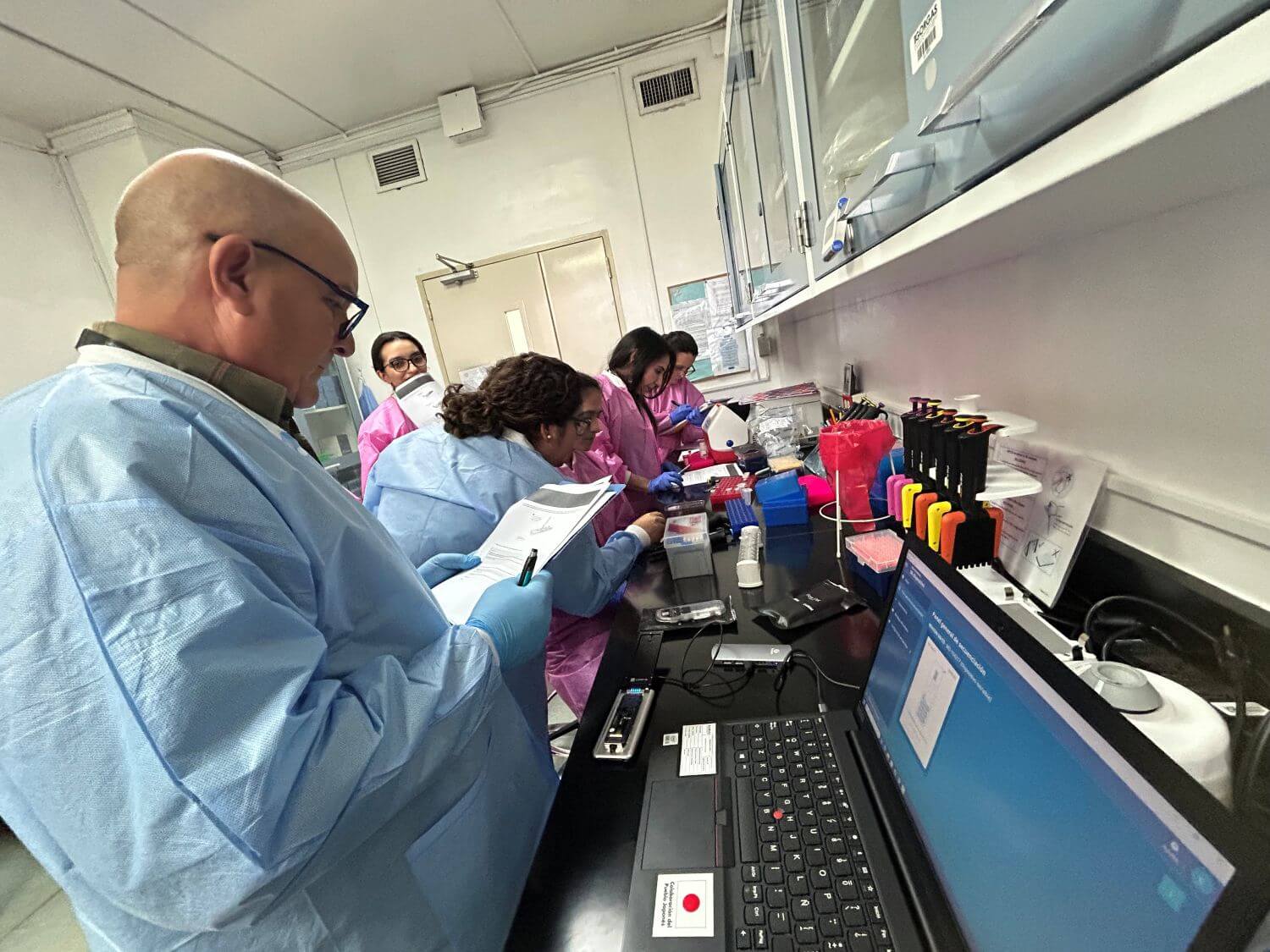
Honduran laboratory scientists, in partnership with APHL and the US Centers for Disease Control and Prevention’s (CDC’s) Global Health Security Partnerships, recently held a sequencing training in Panama for Central and South American countries. It was the first time a Latin American country co-led a regional training alongside APHL, and the first time partners in Honduras helped lead a training under an international trainer-of-trainers (ToTs) model.

A look back
In August 2022, a new project, supported by the Pan American Health Organization and coordinated by Dr. Gabriela Rodriquez Segura, the genomics laboratory coordinator at Honduras’ Laboratorio Nacional de Vigilancia de la Salud (LNVS), created a sequencing space at the laboratory in response to the COVID-19 pandemic.
LNVS sent Drs. Soany Avilez and Karla Romero, two of their scientists specializing in genomics, to the Gorgas Memorial Institute, a medical training institute in Panama, for training in bioinformatics and genomic sequencing. Avilez and Romero subsequently became the first two scientists in Honduras capable of performing SARS-CoV-2 sequencing.
In 2024, APHL supported the doctors in holding a two-week sequencing workshop for laboratory professionals from a variety of backgrounds to learn sequencing skills, followed by a local ToTs session to their LNVS colleagues.
Moving beyond COVID
In December 2025, Avilez and Romero expanded their teaching repertoire to lead, for the first time, a larger-scale regional ToTs program in Panama. With continued support from the Gorgas Institute, APHL and CDC, 17 participants from 14 different countries completed and received a ToT certification in sequencing.
The training represented the first time APHL worked with many countries in the region, including Ecuador, Peru, El Salvador and Belize. Held fully in Spanish, this training allowed several participants to sequence bacteria for the first time using Salmonella spp., a leading cause of foodborne illness worldwide.
“Genetic sequencing is not only useful for identifying viruses like SARS-CoV-2,” explained APHL’s Adolfo Lara, PhD, specialist, Global Health, who was involved in the trainings. “It’s also useful for detecting the genetic fingerprint of bacteria. Sequencing Samonella seemed like a logical next step in the training.”
Designed and delivered by Avilez and Romero through a combination of in-person and remote sessions, the training included an overview of using visualization tools to look at relationships between samples, a mock Salmonella spp. outbreak analysis and instruction on how to use Terra.bio (a platform that allows scientists to upload and access data, run analysis and collaborate with one another).
Expanding reach
Since the training, both Paraguay and Chile have led their own ToT sessions. The hope is that all participating countries will do this eventually, creating a new network for local training and skill building in the region.
“Regional capacity is important,” Lara said. “We are connected as the Americas. Being able to provide support to partner countries allows them to have these tools and knowledge in place to catch infectious diseases, identify them and conduct surveillance so that they’re easier to keep under control at the local, regional and global level. It’s a benefit to us all when we have systems in place to catch pandemic-risk infectious diseases.”
Ampliando la capacitación en secuenciación en las Américas
En 2024, Honduras, con el apoyo de la APHL, fortaleció su capacidad nacional de secuenciación en laboratorios.
Hoy, la iniciativa continúa creciendo.
Científicos de laboratorio hondureños, en colaboración con la APHL y las Alianzas para la Seguridad Sanitaria Mundial (Global Health Security Partnerships) de los Centros para el Control y la Prevención de Enfermedades (CDC) de los EE. UU., impartieron recientemente una capacitación en secuenciación en Panamá, dirigida a países de Centroamérica y Sudamérica. Fue la primera vez que un país latinoamericano codirigió una capacitación regional junto con la APHL, y la primera vez que socios en Honduras ayudaron a liderar una capacitación bajo un modelo internacional de "formación de formadores" (ToTs, por sus siglas en inglés).
Una mirada retrospectiva
En agosto de 2022, un nuevo proyecto —respaldado por la Organización Panamericana de la Salud y coordinado por la Dra. Gabriela Rodríguez Segura, coordinadora del laboratorio de genómica del Laboratorio Nacional de Vigilancia de la Salud (LNVS) de Honduras— estableció un espacio de secuenciación en dicho laboratorio como respuesta a la pandemia de COVID-19.
El LNVS envió a las Dras. Soany Avilez y Karla Romero —dos de sus científicas especializadas en genómica— al Instituto Conmemorativo Gorgas, un centro de formación médica en Panamá, para recibir capacitación en bioinformática y secuenciación genómica. Posteriormente, Avilez y Romero se convirtieron en las dos primeras científicas en Honduras capaces de realizar la secuenciación del SARS-CoV-2.
En 2024, la APHL brindó apoyo a las doctoras para la realización de un taller de secuenciación de dos semanas, dirigido a profesionales de laboratorio de diversas disciplinas interesados en adquirir habilidades de secuenciación; a este taller le siguió una sesión local de formación de formadores (ToTs) dirigida a sus propios colegas del LNVS.
Más allá de COVID
En diciembre de 2025, Avilez y Romero ampliaron su repertorio docente para liderar, por primera vez, un programa regional de formación de formadores (ToTs) a mayor escala en Panamá. Con el apoyo continuo del Instituto Gorgas, la APHL y los CDC, 17 participantes provenientes de 14 países diferentes completaron el programa y recibieron una certificación de formadores (ToT) en secuenciación.
Esta capacitación marcó la primera ocasión en que la APHL trabajó con varios países de la región, incluidos Ecuador, Perú, El Salvador y Belice. Impartida íntegramente en español, esta capacitación permitió a varios participantes secuenciar bacterias por primera vez, utilizando Salmonella spp., una de las principales causas de enfermedades transmitidas por alimentos a nivel mundial. “La secuenciación genética no solo es útil para identificar virus como el SARS-CoV-2", explicó el Dr. Adolfo Lara, especialista en Salud Global de la APHL, quien participó en las capacitaciones. “También es útil para detectar la huella genética de las bacterias. Secuenciar Salmonella parecía un siguiente paso lógico en la capacitación”.
Diseñada e impartida por las Dras. Avilez y Romero mediante una combinación de sesiones presenciales y a distancia, la capacitación incluyó una visión general sobre el uso de herramientas de visualización para examinar las relaciones entre muestras, un análisis simulado de un brote de Salmonella spp., e instrucciones sobre cómo utilizar Terra.bio (una plataforma que permite a los científicos cargar y acceder a datos, realizar análisis y colaborar entre sí).
Ampliando el alcance
Desde la realización de la capacitación, tanto Paraguay como Chile han liderado sus propias sesiones de formación de formadores (ToT). Se espera que, con el tiempo, todos los países participantes hagan lo mismo, creando así una nueva red para la capacitación local y el desarrollo de competencias en la región.
“La capacidad regional es importante”, afirmó Lara. “Estamos conectados como el continente americano. Poder brindar apoyo a los países socios les permite contar con las herramientas y los conocimientos necesarios para detectar enfermedades infecciosas, identificarlas y realizar labores de vigilancia, de modo que resulte más sencillo mantenerlas bajo control a nivel local, regional y global. Es un beneficio para todos nosotros contar con sistemas establecidos para detectar enfermedades infecciosas con riesgo de convertirse en pandemias”.