.png?sfvrsn=a4dc1c5f_6)
APHL Leadership Programs Expand Opportunities for Current and Future Laboratory Leaders
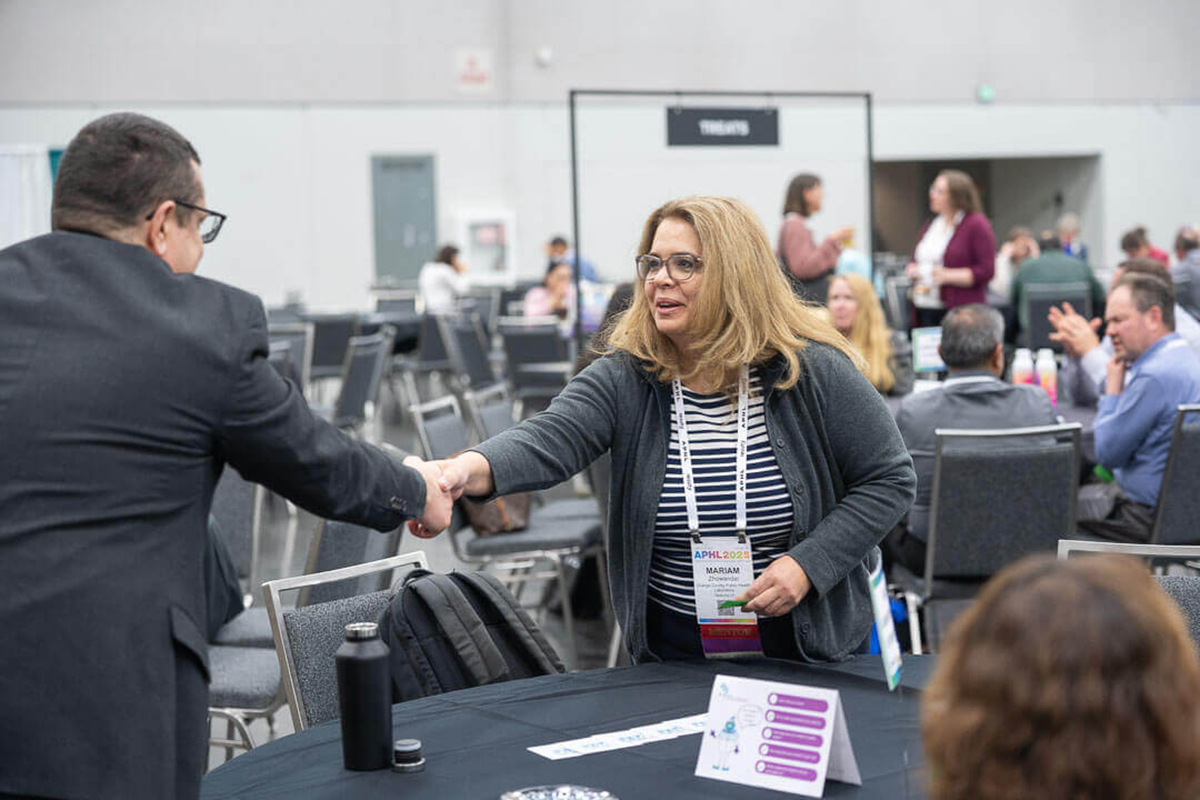
Since its inception, APHL has been committed to supporting leadership development among public health laboratory professionals. But in the past two or three decades, that support became a specific focus at APHL and led to the establishment of programs committed to growing the leadership skills of our members. In that time, we have seen the creation and expansion of APHL’s Emerging Leader Program (ELP), Laboratory Leaders of Today (LLOT) and both of their related alumni groups.
The ELP is an annual leadership development program that offers training opportunities and the chance to collaborate with peers on learning and growth experiences. This year they marked their 20th cohort. LLOT is directed at new laboratory directors, assistant directors and senior laboratory staff to help refine leadership skills while addressing critical operational issues in laboratories.
Many of those who have participated in early or transitional stages of their careers have become laboratory leaders and now encourage their staff to participate as well. One of those program alumna is Kathleen Street who is now the senior manager of leadership development programs at APHL.
Street, who took part in ELP about a decade before she became the leader of the program, embodies the career growth that results from participation in the program. Having worked in the laboratory, as a project manager and now earning a certification in learning facilitation.

The Evolution of ELP
Participation in ELP has grown from 12 to 15 participants a year to 40 to 50 a year. As the program has expanded, so has APHL’s staff focused on these programs growing from a team of two to a team of seven
The staff provides support for the ELP and LLOT programs and has helped with the customization of the programs. The added staff allows for one-on-one meetings with individuals who have application questions or special situations.
“Instead of having the whole cohort go through things that might not be pertinent, we can make the time to help people where they are at,” Street said.
That can make a difference for introverted participants who may be uncomfortable asking questions in large groups.
“We’re supporting two different concurrent ways of delivering that program. We’re supporting hybrid, which is traditional with people coming together around twice a year, and virtual which is a change that has enabled us to bring in individuals unable to travel,” Street said.
The program also provides a network of people who become more than resources.
“My cohort besties are still my cohort besties. Those relationships are so lasting. It’s enabled me through the years to know others who have gone through situations and challenges, and we can discuss best practices,” Street said. The ELP program is expanding with a pilot program for experienced leaders that will begin in November. Street explained that conversations are hard if 80% of a room has a certain level of leadership experience, but there are 20% who are not at that level. Both programs aim to integrate leadership and laboratory but also address the differences in experience.
“That’s one of the customizations we've done as part of our content as well,” Street said. “We're taking what we traditionally do for upcoming leaders and now we're establishing a separate focus specifically for experienced leaders. That is a gap that we are closing,”
Josh Rowland, senior director of experiential learning at APHL and a former ELP participant, says it is gratifying to see the continued success of the program.
“The program, and its alumni programs, offer the needed support for those people on their leadership journey,” Rowland said.
Laboratory Leaders of Today…and Tomorrow
The LLOT program evolved from the US Centers for Disease Control and Prevention’s New Laboratory Director Orientation into a program providing more support, interaction and networking. The updated program has graduated one cohort and preparing for another graduating cohort this fall.
“The focus is traditionally new lab directors and assistant lab directors. For our current cohort we’ve expanded to include senior staff members who may be on a trajectory to serve those roles,” Street said.
The LLOT program’s structure is similar to ELP. Street keeps the structure flexible so the cohort can adapt to what they believe is needed and when they believe it is needed.
“We make sure that they have plenty of time to talk to each other about big picture things and also those details as well, keeping that networking thread is alive,” Street said.
The success of both programs hinges on conquering the most obvious challenge: time. Leadership development activities are always in addition to their daily work responsibilities.
“Folks don’t have two to four hours a month to step outside or shut their door and fully focus on things that are not urgent,” Street said. “Because so many things in their day are urgent and on fire.”
The time challenge can be offset by the relationships that are built.
Networking also offsets difficulties since, even if one person may not have direct knowledge of a particular challenge, a coworker or colleague they know may be able to help.
“That's very special because there's that level of trust and follow-through. You want to keep helping others because you're also getting back from that community, too,” Street said.
As of 2026, two participants of LLOT Cohort 3 were promoted to laboratory director from assistant laboratory director.
In post-program anonymous surveys, one participant shared: “The Laboratory Leaders of Today cohort offered support I didn’t realize I needed, affirming that I’m not alone and that my approach to operations, workforce and sustainability aligns with other directors. It provided a safe, judgment-free space to share, learn and connect, greatly strengthening my leadership journey.”
The ELP and LLOT Alumni Experience
APHL also ensures that the momentum of each cohort continues after the experience through alumni groups.
“We have representatives from labs that serve on little mini committee. We call it an Action Centric Team, where they get to decide what's next and what's the hot topic now being discussed in laboratories,” Street said.
Street added that the alumni come together and continue networking, expanding beyond their cohort. They are able to get that same feel and inspiration so they can go back to their laboratories and share their knowledge with each other.
Street explains that the satisfaction is more than graduations and metrics.
“When folks walk away with that increased confidence, it really is something where you can see that you've made a difference for them. I always hear from folks that the program doesn't just help them at their laboratory, but it helps them be more confident in their personal life and in their own volunteerism,” Street said.
Find out more information about APHL’s leadership development programs here.
Read the full Career Pathways story in Lab Matters.