.png?sfvrsn=a4dc1c5f_6)
Uganda Is Experiencing Its Eighth Ebola Outbreak in 25 Years. How the US Is Staying Prepared
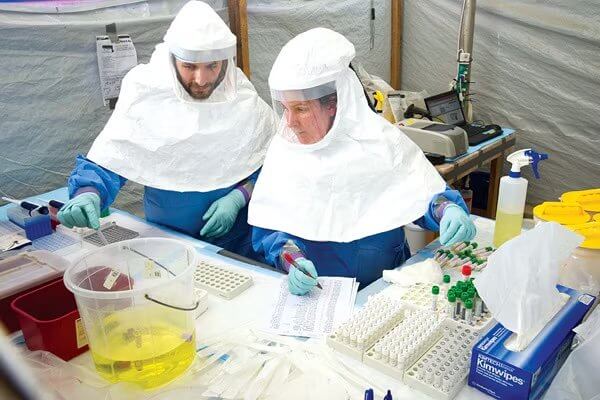
The Ministry of Health of Uganda recently declared an outbreak of Ebola Virus Disease (EVD), its eighth such outbreak since 2000.
The current outbreak is classified as Sudan virus disease (SVD), a type of Ebola with up to a 70% mortality rate. One man in the country has died in the current outbreak and seven others have tested positive. The cases have centered in Kampala, a highly populated area where urban density could make containing the contagious disease particularly challenging.
While Ugandan clinical and public health officials are working with US Centers for Disease Control and Prevention (CDC) to curtail the spread of the virus, without authorized medical interventions to specifically prevent or treat it, there’s little keeping this Ebola disease from landing on other shores, including our own. What is the US doing to prepare should Ebola arrive?

A public health success story
The Laboratory Response Network (LRN) is the nation’s laboratory emergency response system, linking local, state and federal public health laboratories with , food, veterinary, environmental and agricultural laboratories as well as military and international laboratory centers. With their advanced testing capabilities, these laboratories can detect both known and emerging threats before they take hold in communities and develop into outbreaks.
In September 2014, when the first imported case of Ebola arrived in this country at a Dallas, Texas, hospital, the LRN sprang into action.
Like many LRN member laboratories at that time, the Texas Department of State Health Services had been training on an Ebola test kit that received Food and Drug Administration (FDA) emergency use authorization (EUA). That training proved crucial when the biothreat staff at the laboratory were sent a specimen from the ill person (who had traveled from Liberia where there was an Ebola outbreak) for testing. That test came back presumptive positive for Ebola and was then sent to CDC for confirmation.
All in all, 11 people were treated for EVD in the US in 2014; two people died. Nine of the people who contracted the infection, including the two who died, had acquired it abroad.
From 2014 to today
The LRN is ready now, just as it was in 2014.
Seventy-six LRN state and local public health laboratories are equipped with real-time PCR test kits that can rapidly detect the presence of the Ebola virus using a blood sample. “LRN laboratories have verified and validated these tests, trained staff and are ensuring adequate inventory of reagents and supplies.” noted Tyler Wolford, senior program manager of Public Health Preparedness and Response at APHL. “Public health laboratories are prepared.”
The US also now has 13 Regional Emerging Special Pathogen Treatment Centers (RESPTCs) around the country; in 2014, there were only three. These health systems are prepared to detect, diagnose, treat and transport patients with Ebola without infecting others. In addition to RESPTCs, the country has a network of Ebola treatment centers, assessment hospitals and front-line healthcare facilities all prepared to rapidly identify, isolate and treat (where appropriate) Ebola patients.
Why funding matters
The US is well-prepared to handle Ebola cases, but that could all change on a dime—literally.
APHL, with the help of critical funding from CDC, supports the LRN through training, quality improvement initiatives, surge capacity and exercise planning, policy development and the fostering of partnerships. During responses, APHL plays a crucial role in supporting state and local public health laboratories to ensure they can provide quality and timely testing.
Without adequate funding for the LRN and a strong public health infrastructure in general, public health officials will have an increasingly difficult time identifying, containing and ultimately stopping outbreaks of diseases like Ebola, which are largely imported from other countries, from invading our shores.
“Even though there are no cases here currently,” said Chris Mangal, senior director of APHL’s Public Health Preparedness and Response program, “the disease could—and has—come here. And if it does, we will need testing to stop it. The majority of the staff who test for Ebola are federally funded. We need those dollars, and those public health professionals, to stop the spread of disease.”