.png?sfvrsn=a4dc1c5f_6)
Academic Partnerships Prove Valuable to Both Laboratory Recruitment and Outreach
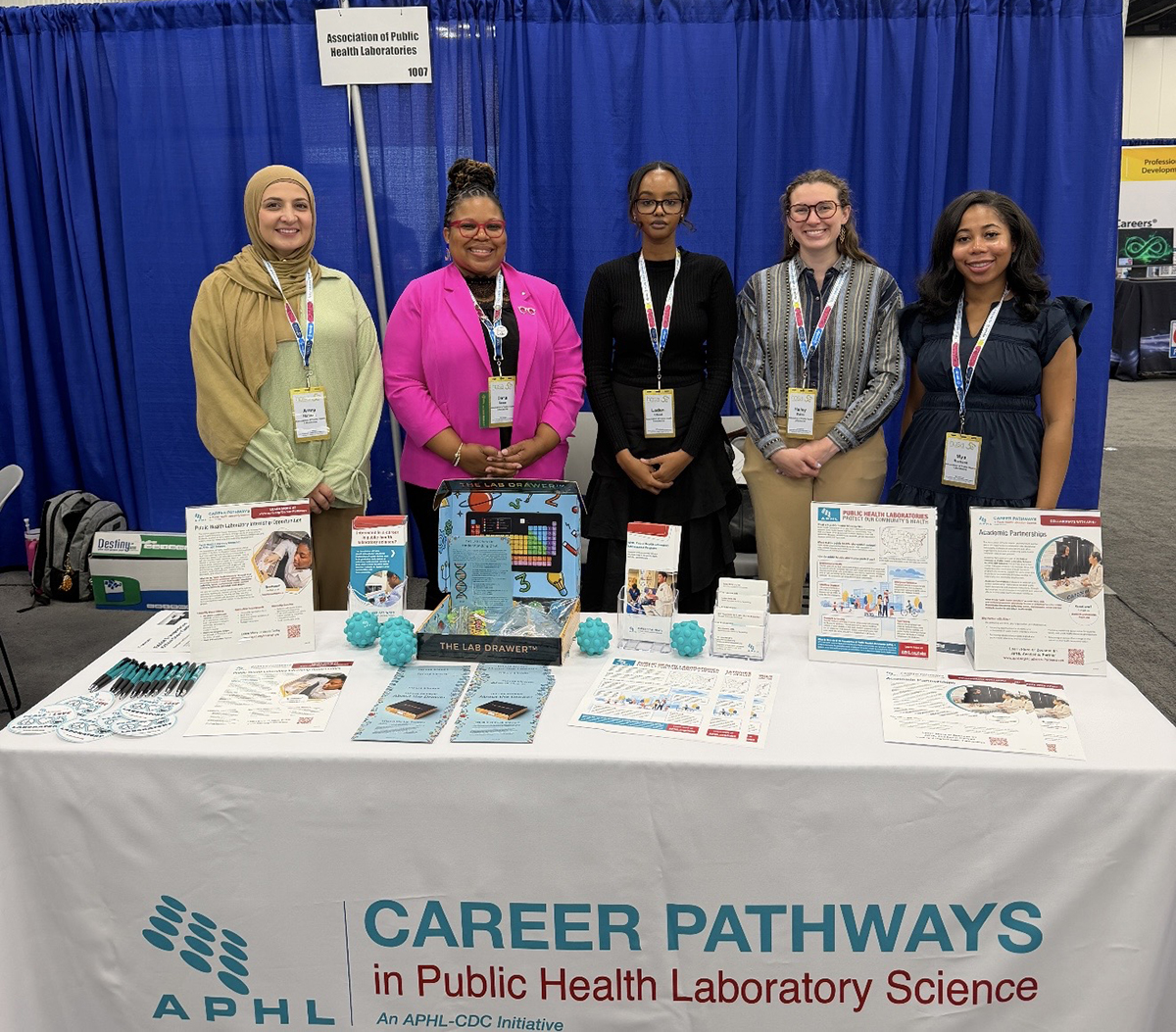
With the creation of the Career Pathways in Public Health Laboratory Science: An APHL-CDC Initiative and the newly expanded Public Health Laboratory Fellowship and Internship Programs, APHL would begin establishing new relationships with academic institutions for outreach and recruitment. The Academic Partnerships program was created out of this need.
Dana Baker, EdD, senior manager for academic partnerships, was tasked with taking what started as a work group and developing an operational, dedicated program to support recruitment.
“I was looking at the development of an outreach strategy and one that would be able to support the recruitment needs we would have in identifying qualified talent from academic institutions,” Baker said.
Baker saw the opportunity as manning the frontline of fellowship and internship recruitment was the point that initially exposed students to public health laboratory career options and the Career Pathways program.
“Whether it was through career fairs, conferences, info sessions, either virtual or in person, we are getting the word out and increasing awareness about opportunities so that students interested—or even those who were looking for a career transition—would definitely leverage that opportunity for either an internship or a fellowship," Baker said.
There was also the added charge of fostering collaborative relationships with academic institutions. Many of the relationships are without any formal agreements, but that is not to say there aren’t agreements with individual institutions.
“There are some [formal] agreements like the one with the University of South Florida and their Doctor of Public Health program. We also have just executed an agreement with Virginia Commonwealth University for their summer immersion program,” Baker said
While outreach seemed like it would be straightforward, there was an interesting and persistent hiccup. Many interactions started off with the question of “what are public health laboratories?”
“It was a call to action,” Baker said. “We needed to educate candidates on what public health laboratories are. We spent time focusing on what they do to help protect the health and well-being of communities, to mitigate those emerging threats, and getting into what those focus areas can even look like.”
They also looked to raise awareness of the proximity of public health laboratories within their region.
Baker notes one recruitment that embodies all these aspects of the Academic Partnership team’s work. In 2023, the first year of both the academic partnership and internship programs, there was a career fair at Tennessee State University in Nashville. Baker and Cherie Estrada, lead specialist, fellowship and internship programs, coordinated APHL’s participation at the fair.
At the fair, a Tennessee State University student, Kamren Williams, approached Estrada at the booth and expressed interest in an internship opportunity. Estrada encouraged him to apply.
“He had never considered an internship in public health laboratories. I think that was his first exposure to what a career path in public health laboratories can look like. He was one of our first interns. He was placed at the Tennessee laboratory and had a very successful internship,” Baker said.
But Williams’s pathway continued beyond the internship. After his internship was completed, he was hired as a full-time employee.
“What I really love about it is that he doesn't necessarily come from a traditional major in the sense of he's not a biology or chemistry major,” Baker said. “He really highlights that you didn't have to be a science major to qualify for the internship, but the internship did what it was supposed to do in terms of exposing him to a career path, gaining skills, receiving that dedicated mentorship and showcasing his willingness to learn.”
If you visit the Tennessee laboratory now, Williams would likely be your tour ambassador.
“He immersed himself and absorbed the full experience. He can walk you through that laboratory like he’s a veteran,” Baker said. “He is still connected with us now, he even co-presented at this year’s APHL Annual Conference. It felt like a full-circle moment. That was amazing.”
Baker and her team all attend conferences, job fairs and other outreach events. And they continue to address their continuous challenge: visibility.
“We are behind the scenes. After that first-time engagement, we are not going to come to the forefront of people’s minds,” Baker said. “The opportunity for us is to think more broadly about outreach strategy and increasing visibility as to what we do in academic partnerships.”
Another aspect of the program is creating opportunities for early exposure to laboratory science for K-12 students.
“It is vital to get with educators, students and counselors so they can become our advocates and allies in their daily engagement with their students,” Baker said. “They can integrate foundations of public health laboratory science into their curriculum.”
Baker continued that educators may have students with an interest or maybe spark an interest in a career as a scientist. The opportunity comes when the educator can ask, “have you thought of a career in public health laboratories.’
“At the end of the day, we want people to be aware of career paths. It isn’t enough to be at a career fair or at a conference to engage in one-off types of interactions like these, Baker said. “But it's also vital to engage with the people who are in front of these classrooms, in front of these students so they can also support us in the promotion and visibility of these essential careers.”
Another avenue for outreach is the Public Health Laboratory Ambassadors program. Developed by Emerging Leaders Program (ELP) Cohort 16, ambassadors are public health laboratory staff who volunteer to perform outreach to STEM classes, the public or at job fairs and conferences.
The program has grown to over 200 ambassadors, which includes all levels of public health laboratory staff and now, fellows as well.
The feedback from the outreach can be revitalizing, according to Baker.
“I think one of my favorites is anytime someone reacts excitedly and goes, ‘I didn't even know anything about this.’ I mean, they are waving their hands with it,” Baker said. “That's why we're here to make people aware about public health laboratories and even more so about internships and fellowships in public health laboratories.”
Read the full Career Pathways story in Lab Matters.