.png?sfvrsn=a4dc1c5f_6)
Lab Scientists Under the Microscope: Meet Jason Wholehan
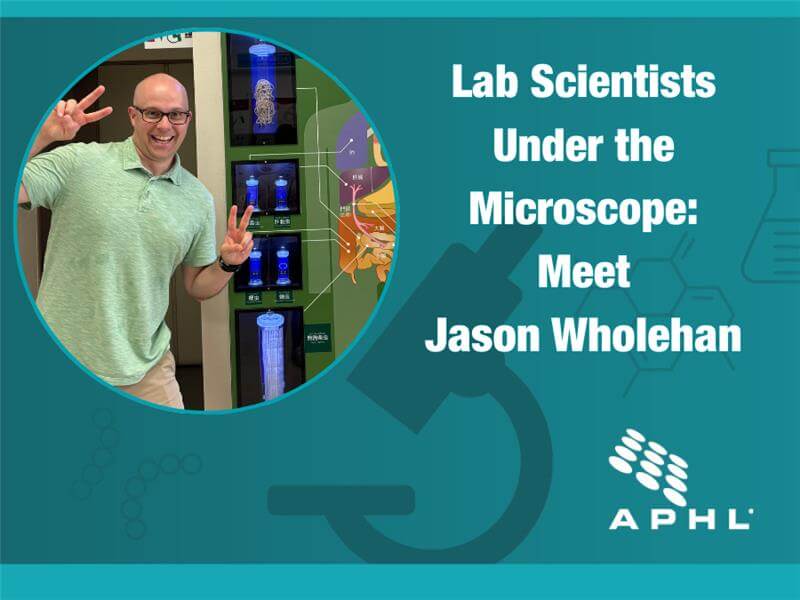
In celebration of Lab Week 2025, we put a handful of laboratory scientists under the microscope, peppering them with questions that shine a light on their professional and personal lives. What were their career dreams as kids? How do they relieve stress when they hang up their lab coats and safety goggles? What do they wish we all knew about their jobs?
Each day of Lab Week, we’ll highlight one of these professionals and give you a peek at their passions and personalities, the things they love about laboratory science and the things they’d rather forget (we’re looking at you, disseminated strongyloides).

Jason Wholehan, health and safety officer, Michigan Department of Health and Human Services, Bureau of Laboratories
What did you want to be when you were growing up?
When I was a kid, I don’t remember having a clear idea of what I would do as an adult. And that was something that followed me into my freshman year at Michigan State University where I was admitted as “No Preference.” I found laboratory science as a degree field completely by accident. I was attending a “parade of majors” event where “No Preference” freshmen could explore potential degrees and I happened to look through a book with descriptions of majors. I saw “clinical laboratory science” and thought that sounded interesting enough. The rest, as they say, is history.
What was your first job?
My first paying job was working behind the scenes at my high school theater, running sound and lights. I see a lot of similarities between technical theater and laboratory science—you work with some very expensive and complicated equipment and perfection is not just the goal, it’s a requirement. No one wants to see a show with missed lighting cues and terrible sound, and no one wants laboratory results that aren’t of the highest quality or are inaccurate. Both positions are really the unsung heroes of their disciplines. The theater can’t operate without lights and sound and healthcare decisions often rely on laboratory results.
What was your first laboratory job?
During my last year as a student at Michigan State, I worked at the plant pathology laboratory on campus. The principal investigator whom I worked with focused on small fruits and their diseases. It was a great summer job. I traveled around Michigan to various blueberry farms collecting samples and studying the fungi that threaten them. Looking at a blueberry covered in fungus under the stereoscope was like being transported to a very different and colorful world.
What’s the most interesting, unique, disgusting (add your own adjective) specimen/sample/case you ever worked on?
I started my career at a hospital microbiology laboratory and saw a lot of “interesting” things. We got a few amputated toes to culture along with a steady stream of thick, strangely colored sputum. One interesting case involved an elderly gentleman who had become immunocompromised and developed a disseminated strongyloides infection (small parasitic worms). Every sample sent to the lab had worms, and they could be seen under the microscope on smears. The worms would crawl around the culture plates making them look very strange.
What’s your favorite non-science item in your lab?
I have a small stuffed desk yeti that protects my desk from evil spirits. I think he’s done a good job so far. But to make his job a little more difficult, I surround him with stuffed bacteria and viruses. He has a lot to contend with. Now he is covered in Ebola, malaria, MRSA, E. coli and more!
Laboratory science is serious work. What do you do to unwind?
I like to travel. My wife is also a laboratorian and when we travel, we always try to find hidden health histories or laboratory-themed sites. We’ve been on lots of city walking tours that focus on the health history of that place. We recently traveled to Tokyo, Japan, where we found a really cool museum, the Meguro Parasitological Museum. They had lots of displays of parasites and preserved specimens to look at.