.png?sfvrsn=a4dc1c5f_6)
One Health, Many Partners: Three Public Health Labs Highlight How Their Collaboration With Promega Powers a Healthier World for Humans, Animals and the Environment
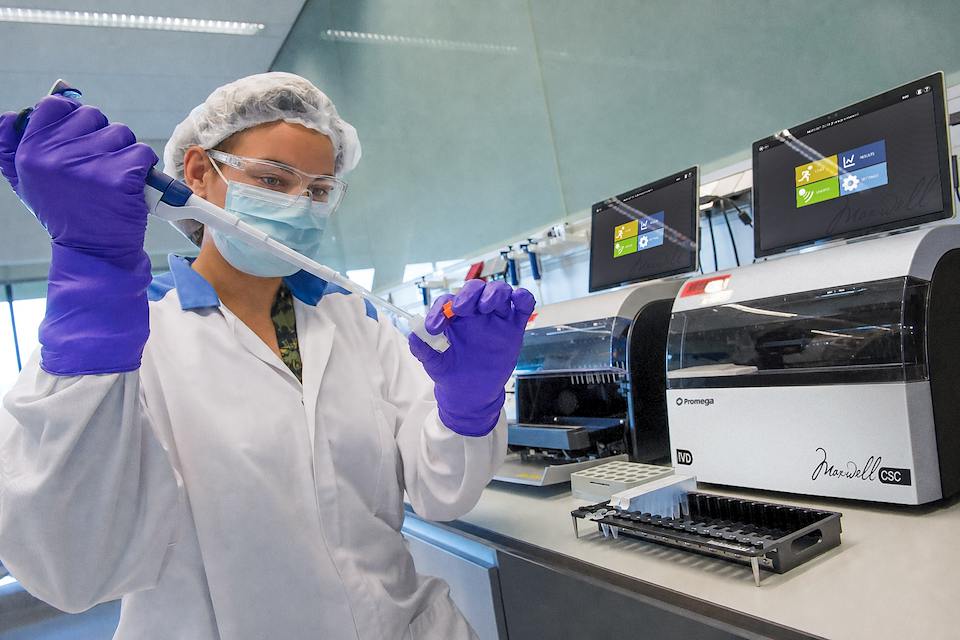
In celebration of Public Health Laboratory Appreciation Month, Promega is partnering with APHL to spotlight the work of public health laboratories and their use of Promega’s technology to strengthen One Health principles. This is a sponsored article written by APHL on behalf of Promega, a Platinum Level Sustaining Member. Read on to learn more about the labs and their work with wastewater surveillance, Legionella and C. auris, and to celebrate the important impacts their partnerships with Promega have had on advancing One Health.
In today’s interconnected world, what affects one community, species or even habitat can affect another—and yet another. It’s a domino effect wherein a pathogen, risk factor or environmental change can trigger a chain reaction of events having far-reaching consequences.
This interconnectedness is a concept known as One Health, or what the US Centers for Disease Control and Prevention (CDC) defines as the recognition that the health of people is closely tied to the health of animals and the environment in which we co-exist.
“One Health starts from an awareness that human, animal and environmental health are inseparable—and that the science protecting one domain ultimately strengthens all of them,” said Julie Yang, director of Promega’s Applied Markets Business Unit. “Public health laboratories have long championed the One Health view, and they remain among its most important sentinels. Each public health lab is also resource-limited and unique. Promega’s role is to support them with tools that are standardized enough to be reliable, yet flexible enough to fit each lab.”

Rapid detection of deadly pathogens
Candida auris (C. auris) is a potentially deadly fungus that’s alarming public health partners around the world due to the ease in which it spreads, especially among those who are immunocompromised, and its robust resistance to antifungal medications. It was only first identified in 2009, although experts suspect it had been in the environment long before it made the jump to humans.
The CDC notes there were 6,304 clinical cases of C. auris reported in the country in 2024, with roughly 10% of those cases occurring in Nevada alone. Keeping up with the state’s testing demand was becoming a challenge, said David Hess, PhD, research associate professor at the Nevada State Public Health Laboratory.
“About four years ago, we became aware of several C. auris outbreaks that are still ongoing in Nevada,” Hess said. “We wanted to scale up to a rapid response for testing, and the only platform available at the Nevada State Public Health Laboratory that provided the kind of high throughput we needed was Promega’s Maxwell System.”
Partnering with Promega on acquiring and learning the Maxwell System enabled the Nevada laboratory to ramp up testing. “In our lab, we were able to move from testing about eight samples at a time to 50,” Hess said. “There were many weeks we were testing 500 C. auris samples. If we could only do eight at a time with PCR, there would be no way we could have kept up.”
And when it comes to detecting C. auris in a patient, fast action is everything. Think of a person brought into a burn unit, Hess said. If C. auris is on the skin, it can easily travel into the bloodstream with deadly consequences.
“With classic microbiology, it can take five days to grow C. auris on a plate,” Hess stated. “But these patients can’t wait several days for an answer. And if the fungus started spreading within a burn unit, that would be catastrophic.”
For Promega, partnering with public health labs is a mission alignment, not a market strategy.
“When we work alongside labs, the goal is straightforward: help them solve real problems in real time,” Yang said. “The partnership converts science into public health outcomes: faster outbreak detection, more reliable surveillance, workflows that hold up under pressure across agencies and geographies.”
Disease detection through wastewater surveillance
Wastewater surveillance is a rapid and cost-effective tool for the early detection and monitoring of disease outbreaks in communities—from COVID-19 to measles to emerging zoonotic threats like avian influenza (H5N1).
“The nature of wastewater monitoring is very One Health-centric,” said Dagmara Antkiewicz, PhD, a senior scientist at the Wisconsin State Laboratory of Hygiene (WSLH). “And if you want a good monitoring system, especially for [diseases] that change dramatically and dynamically, you need a fast data turnaround time. This is where partnerships between public health professionals, laboratories, federal agencies, academia and commercial entities are critical. To have people whom we trust, whom we can submit samples to, whom we can work with to develop new instrumentation—that’s huge.”
The partnership between the WSLH and Promega proved especially valuable during the COVID-19 pandemic, when wastewater surveillance programs grew exponentially. Promega, with input from the WSLH, developed an extraction kit optimized for wastewater monitoring. “It had a relatively high throughput and gave our lab the ability to extract up to 96 samples at a time. What’s more, the kit promised to work for a variety of pathogen targets,” Antkiewicz said.
After WSLH put the kit into action, they reported back to Promega about what worked—and what didn’t.
“Having this honest back and forth with Promega helped us get a better product and a better system in place,” Antkiewicz stated. “This kind of collaboration and dialog has really helped move the field forward.”
And when one field moves forward, so can another.
“A lab that establishes a trusted methodology in one area often finds the same scientific principles carry into the next challenge,” Promega’s Yang explained. “That progression, from one application to many, from a single disease domain to the full One Health spectrum, is where the real impacts accumulate.”
Real impacts that not only support the One Health initiative, but go beyond it, particularly when the communication between partners is clear and collaborative, noted Martin Shafer, PhD, a senior scientist at WSLH.
“Being able to talk openly with companies about laboratory needs and to have companies talk openly about their technologies and tools—it all works to advance public health and science overall,” he added. “We can’t improve science if everything is proprietary.”
Faster public health decision-making
New York State is seeing an increase in infections caused by Legionella, a naturally occurring bacteria found in water and soil. The bacteria can become deadly when it grows in poorly maintained water systems and then becomes airborne. The New York State Department of Health reports that cases of Legionellosis, an infection caused by Legionella bacteria, increased from 4.1 per 100,000 residents in 2022-2024 to 6.1 per 100,000 in 2025.
Getting test results fast is always of the utmost importance, but it becomes especially essential when confirming cases of Legionnaires’ disease, a type of Legionellosis that's caused by Legionella and is fatal in 10% of patients.
“Our partnership with Promega has helped strengthen our laboratory's ability to deliver timely and reliable results,” said Danielle Wroblewski, a research scientist at Wadsworth. “Their technologies and support, including instrument demo trials, have provided the ability for us to streamline our workflow and reduce turnaround times for our Legionella testing. This has enabled us to support outbreak investigations with accurate molecular testing and generate high-quality data that informs public health decision-making. The Wadsworth Center-Promega partnership has also given us access to innovative tools and technical expertise, allowing us to implement testing that improves response to emerging public health challenges while maintaining high standards of quality and accuracy.”
One such innovative tool, Wroblewski points out, is Promega’s Legionella free reagent automated extraction system, which has helped the center’s Bacteriology Laboratory streamline its workflow by providing reliable reagents and consistent performance. It’s a tool that’s allowed the lab to reduce the need for repeat testing, decrease technician hands-on time and simplify day-to-day operations.
“As a result, we've been able to process samples more efficiently and deliver results more quickly, supporting faster public health decision-making during Legionella investigations,” Wroblewski said. “The improved workflow has also allowed our team to spend more time interpreting data and responding to potential public health concerns rather than troubleshooting laboratory processes. Overall, the partnership has strengthened our capacity to detect and investigate Legionella while improving the consistency and efficiency of our laboratory operations.”
Improving laboratory operations is at the very core of Promega’s mission, emphasized Yang.
“Our role is to reduce friction. It’s to ensure that the science that laboratory professionals are conducting has a reliable, reproducible foundation so their team can focus on interpretation and impact, not troubleshooting methodology,” she explained. “That is what it means to support a mission, rather than supply a product.”
Supporting a mission, not just a product
Whether it’s with innovative instrumentation, hands-on training or long-term technical support, improving laboratory operations is at the very core of Promega’s mission, emphasized Yang.
“Our approach starts with understanding what a lab is trying to accomplish—the public health problem they are working to solve, the community they are protecting, the constraints they are operating under,” she said.
To do that, Yang explained, Promega stays involved from beginning to end. The company works with laboratory partners to co-develop protocols and support field evaluations—sometimes for extended periods—so solutions can be independently validated and integrated into a new workflow. They co-present at conferences; conduct educational events; participate in working groups; and stay engaged as the science evolves.
“For us, the relationship doesn't end when a method is established,” Yang said. “We maintain year-round engagement with our public health laboratory partners. It’s an ongoing relationship where we learn alongside the labs and grow together. This is what it means to support a mission, rather than supply a product.”