.png?sfvrsn=a4dc1c5f_6)
Waste Not: Building a Wastewater Surveillance System in Zambia
How effective a tool is wastewater-based surveillance (WWBS) in detecting diseases of public health importance in real time? Can it sound an alarm bell on emerging pathogens, including the specific strains of the pathogens? How feasible is it for countries to develop WWBS programs?
These are questions public health practitioners and laboratory professionals around the world are interested in answering.
To that end, in 2023 the Association of Public Health Laboratories (APHL), began in-country collaborations with Zambia’s Ministry of Health (MoH), the Zambia National Public Health Institute (ZNPHI) and the Churches Health Association of Zambia (CHAZ) to build capacity for WWBS under Project Stellar, a program financed by the Global Fund. The program supports six African nations, including Zambia, to pilot the feasibility and effectiveness of WWBS for molecular detection and whole genome sequencing of SARS-CoV-2, as well as the potential to detect other pathogens.
WWBS involves taking samples collected from sewer systems and analyzing them to detect and monitor for the presence of pathogens and/or their biomarkers.
“WWBS can help us understand the disease burden within a defined community,” said Lugard Sichalwe, an APHL senior laboratory technical manager based in Zambia. “It complements clinical-based surveillance as it can support testing in vast populations with limited access to clinical testing. It has the capability to capture proportions of both symptomatic and asymptomatic individuals and can provide early warning of a potential outbreak or resurgence of a disease to guide public health response.”
WWBS in Zambia
Six sewer sites managed by the Lusaka Water Supply and Sanitation Company (LWSSC) in selected parts of Lusaka District, Zambia, were approved for sampling. The six sites collectively service over one million residents.
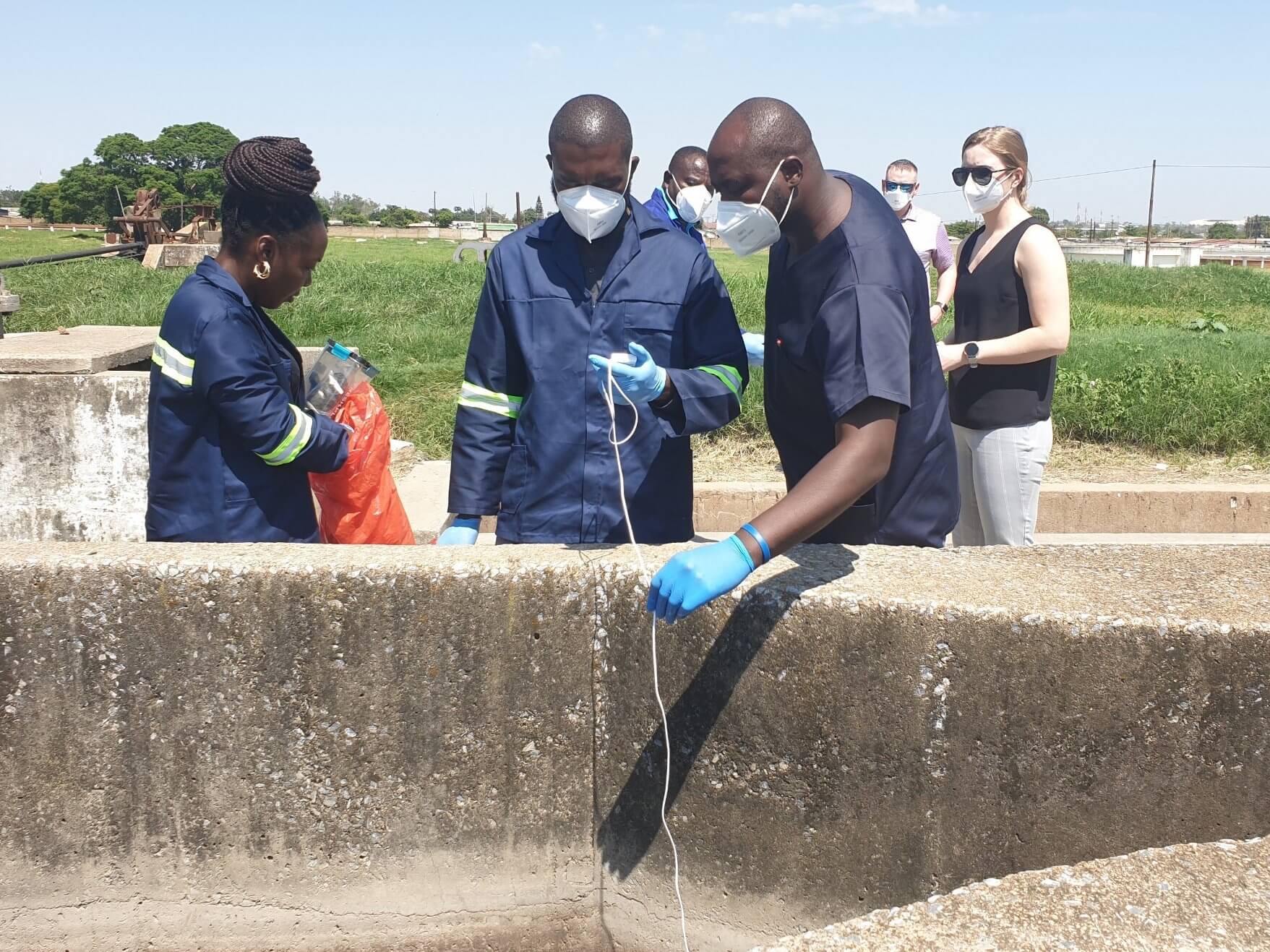
Untreated wastewater composite samples were collected using a Moore swab, an environmental surveillance tool that consists of a sterile cotton gauze pad tied to a string, submerged in wastewater for 24 hours.
“This allows for a continuous filter and trapping of transiently present microorganisms in wastewater for subsequent isolation and testing at laboratories,” Sichalwe explained. “Samples were collected three times a week from each of the six sites. In keeping with best practices, all samples were triple packaged and temperature monitored. Documentation was verified before shipment to the testing laboratories,” added Jay Sikalima, manager of the CHAZ laboratory.
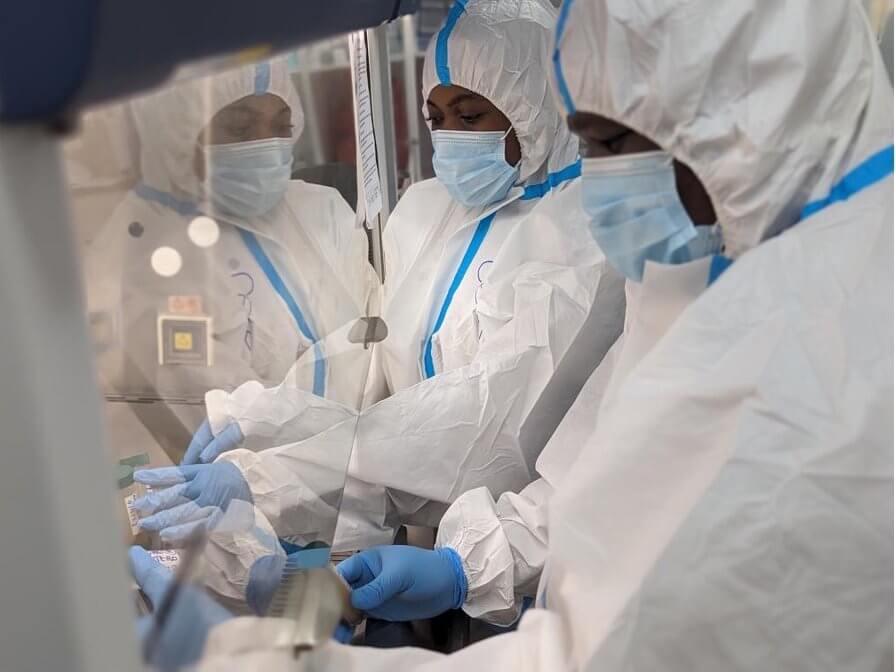
In the testing laboratories, the samples were concentrated to optimize the capture of viruses. The genetic material of the viruses was then extracted and tested by PCR.
“PCR allows for the detection of the presence/absence of SARS-CoV-2 in the samples and or the monitoring of levels of circulating SARS-CoV-2 in the catchment areas,” Kapona Otridah, the Zambia National Public Health Reference Laboratory (ZNPHRL) manager, noted. “Next-generation sequencing was later conducted on a subset of positive samples following PCR testing to help identify and track the potential SARS-CoV-2 strains circulating in the community. This provided a representation of the type of circulating pathogens, whether existing, remerging or novel.”
The results
Between November 6, 2023 and February 29, 2024, a total of 312 samples were collected, of which 207 were positive for SARS-CoV-2. That’s a positivity proportion of 66%.
WWBS showed a notable peak in SARS-CoV-2 positivity rates about seven days prior to an increase in clinically positive cases. What’s more, WWBS was able to detect which variants were circulating in the monitored areas—and it did so much earlier than clinical samples. In fact, WWBS identified the first JN.1 Omicron variant in the Lusaka District as early as November 15, 2023, while the first clinical samples were first reported on January 5, 2024, 51 days later.
“This demonstrated that wastewater samples are more likely to pick up variants earlier than clinical-based surveillance,” Dr. Mulenga Chilufya, epidemiologist and ZNPHI WWBS focal person, said. “This is especially important with novel or emerging variants and whether they are present within a specific geographical region.”
What’s next?
APHL continues to work with stakeholders to expand WWBS capacity in Zambia. Dr. Chilufya is optimistic that more collection sites will be added to increase the geographic coverage of this surveillance program, as well as the number of targeted pathogens and their biomarkers. This will include organisms such as Vibrio cholerae and the analysis of antimicrobial resistance markers.
“Building local capacity through technical assistance and support from APHL has been critical to assuring efficiency of the pilot and giving us the potential for expansion,” Davy Nsama, MoH assistant director, Laboratory Services, said, adding that stakeholder collaboration with MoH, ZNPHI and CHAZ has helped enhance program harmonization, coordination and implementation.
More stories from our global health wastewater surveillance series:
- Testing the Waters: Ethiopia Pilots a Wastewater Surveillance Program
- Eyes Below the Surface: Wastewater Surveillance Pilot Program in Uganda Shows Potential for Future Pandemic Monitoring