
Whole Genome Sequencing Detects Regional Cluster of New Delhi Metallo-β-lactamase Carbapenemase-producing Klebsiella pneumoniae in New York
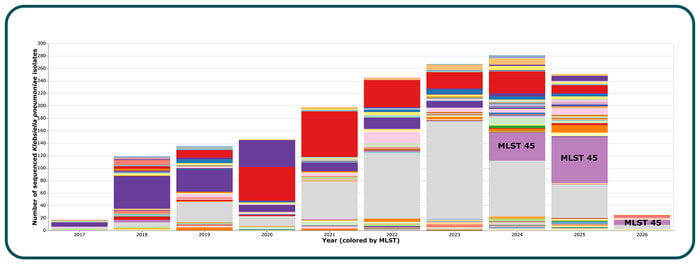
Count of all sequenced Klebsiella pneumoniae isolates at Wadsworth Center by year, colored by multi-locus sequence type (MLST). The outbreak strain, MLST 45, is colored in light purple.
In November 2024, epidemiologists from the New York State Department of Health identified six residents of the same nursing home with highly antimicrobial-resistant Klebsiella pneumoniae (KPN) infections. Isolates from these patients had been sent to the Wadsworth Center, the Northeast Regional Laboratory for the Antimicrobial Resistance Laboratory Network (AR Lab Network), where they underwent whole genome sequencing (WGS). The results revealed that all isolates belonged to the same multilocus sequence type (MLST 45) and carried the same variant of the New Delhi metallo-β-lactamase carbapenemase gene (blaNDM-5). To assess whether the isolates were genetically closely related, the epidemiologists requested a relatedness analysis.

Building a History…
Wadsworth Center’s in-house bacterial relatedness pipeline, BactoCluster, is routinely used to analyze all KPN isolates that undergo WGS, including all submitted blaNDM-carrying KPN isolates from the Department of Health. Each isolate is compared against all previously sequenced isolates in the database. The six isolates from the nursing home were found to be closely related to 18 additional KPN isolates, all collected in 2024 from the same region of New York as the nursing home. No other KPN sequences in the database were closely related to this group of 24 isolates.
The outbreak continued to expand in 2025 as epidemiologists investigated links between the affected patients and requested colonization screening of other residents in impacted facilities. Swabs collected during these screenings were tested at Wadsworth Center, identifying additional patients colonized with the outbreak strain. To further characterize the strain, Oxford Nanopore-based long-read WGS was performed, revealing that the blaNDM-5 gene is located on a plasmid carrying eight additional antimicrobial resistance genes. Highly similar blaNDM-5-carrying plasmids were also identified in three unrelated KPN MLSTs and one Enterobacter hormaechei isolate from the region collected in 2024 and 2025. These findings suggest that, in addition to clonal expansion of the outbreak strain, horizontal transfer of the outbreak-associated plasmid is occurring among unrelated bacteria. Testing of municipal wastewater in the region in 2025 has also identified both the outbreak strain and a Klebsiella oxytoca isolate carrying a similar blaNDM-5 plasmid, further suggesting its apparent horizontal transfer. The outbreak strain has continued to be identified among clinical isolates from the region in 2026 but has not yet been identified outside the region.
…to Make the Case for WGS
This outbreak highlights the value of WGS for identifying outbreaks, particularly in high-prevalence settings such as New York where blaNDM is more common. The integration of long-read sequencing and wastewater surveillance further helped define the scope and transmission dynamics of the outbreak. ELC funding (AR Lab Network and Advanced Molecular Detection (AMD)) as well as AR Lab Network-supported testing and surveillance were crucial in both the initial identification of the outbreak and ongoing testing and monitoring.
In response to this outbreak, Department of Health epidemiologists in collaboration with the US Centers for Disease Control and Prevention (CDC) launched a statewide infection prevention and control initiative consisting of a series of educational webinars and a statewide roadshow. The goal of this initiative is to increase awareness of AR Lab Network testing available at Wadsworth Center and to reinforce the importance of infection prevention and control practices in reducing the spread of antimicrobial-resistant organisms in healthcare facilities.
We would like to acknowledge our epidemiologist colleagues from the Department of Health’s Western Regional Office Healthcare Epidemiology and Infection Control Program and Bureau of Healthcare Infections, and from the CDC Division of Healthcare Quality and Promotion and Epidemic Intelligence Service Office, for their collaboration and work on this investigation.